
Disarm the mind, capture the state
Disinformation threatens democratic power by compromising the institutions through which people investigate claims, judge evidence, and challenge authority.
Topic
Critical and practical work on AI, educational sovereignty, teaching, learning, and institutional responsibility.
Disinformation threatens democratic power by compromising the institutions through which people investigate claims, judge evidence, and challenge authority.


After EdWeek Market Brief’s K-12 Futurecast with Michelle Caffrey and Katherine Prince, John Moravec reflects on educational sovereignty, teacher judgment, and the risk of human attention becoming a premium service.
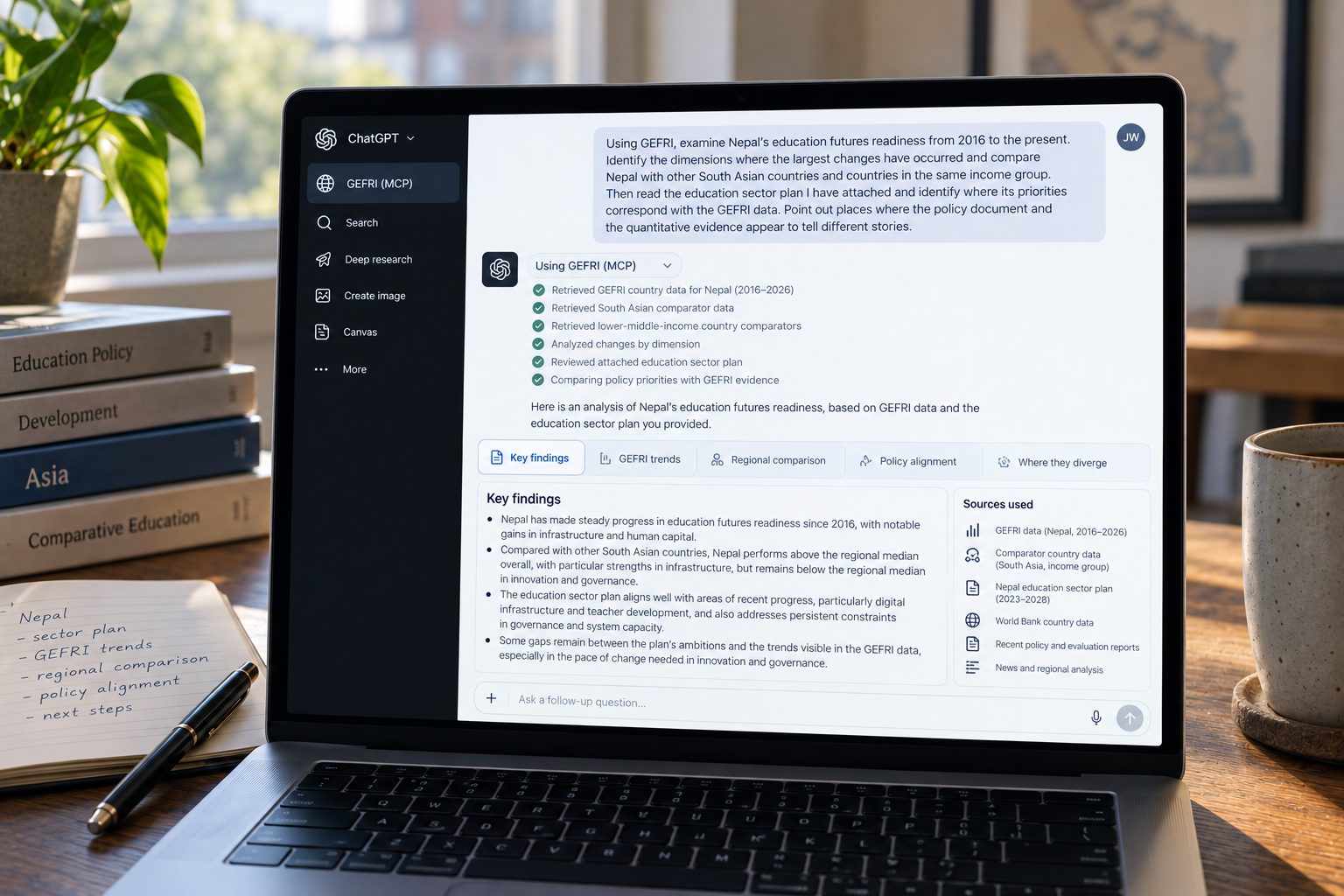
AI assistants can now connect directly to GEFRI to work with current and historical data, compare countries and regions, and interpret results alongside other sources and contextual knowledge.

As AI takes on more codified work, schools need to develop the personal knowledge people use to create new value.
This paper examines how artificial intelligence can reproduce colonial patterns in education and knowledge production. It calls for educational sovereignty, institutional responsibility, and more critical approaches to AI policy.
This article argues that education’s central crisis is not artificial intelligence but institutional imagination. It examines why schools reproduce outdated pedagogies even when new technologies make other possibilities visible.
This article examines what school phone bans reveal about control, trust, and the purpose of education. It argues that the debate is less about devices than about how institutions understand learning and student agency.
Alex Karp (2026), CEO of Palantir, recently framed AI as a force that will reduce the power of “highly educated, often female voters, who vote mostly Democrat,” while increasing the power of non-college-educated, working-class men.

Big Tech shapes what schools can teach and how knowledge circulates through AI platforms. Education needs the capacity to govern these systems in the public interest.
This article explores how gamifying cheating with AI can turn misconduct into an opportunity for learning. Education Futures uses play to encourage curiosity, ethics, and reflection about how technology is used.
” The answer, I argued, is not really. It is a tool, just like a calculator or book, that can enhance human capacity.

AI has renewed debate about learning, memory, and creativity in an age of cognitive offloading. Cognitive offloading means using tools to do mental work we could do ourselves.

When Sir Ken Robinson delivered his now-iconic TED Talk in 2006, proclaiming that “schools kill creativity,” he struck a chord that continues to reverberate through education systems worldwide. Robinson’s argument that our schools systematically squash imagination in favor of conformity and compliance sparked a movement for more creative, learner-centered approaches.

AI Trends in Higher Education,” hosted by Emerald Publishing and the Higher Education Teaching and Learning Association (HETL), March 26,.

Recent developments illustrate how easily facts can be dismissed when they become politically inconvenient. Donald Trump’s return to the presidency of the United States signals a shift from mere pressure tactics to the outright dismantling of government agencies focused on public health, equity, climate monitoring, and air traffic control oversight, among other critical areas.

The modern internet is aging, and the cracks are showing. For nearly three decades, we have built online spaces rooted in structures that, while groundbreaking at the time, now struggle to serve the ways we live, work, and learn today.

Last week, I had the privilege of presenting the closing keynote at the International Meeting on Educational Innovation and STEM Teaching hosted by Instituto Tecnológico de Buenos Aires, Argentina, where I shared my perspectives on the urgent need to rebuild higher education from the ground up and on the importance of pre active leadership.