Education Futures2026-06-08T08:32:41-05:00Education Futureshttps://educationfutures.comNew paper: AI, coloniality, and educational sovereigntyJohn Moravechttps://educationfutures.com/post/new-paper-ai-coloniality-and-educational-sovereignty/2026-06-02T16:58:23-05:00
The rapid adoption of generative AI in education has often been framed through the language of “readiness.” Institutions are…
]]>
The rapid adoption of generative AI in education has often been framed through the language of “readiness.” Institutions are encouraged to develop policies, train staff, clarify acceptable use, and prepare learners for participation in an AI-mediated future. These are important tasks, but they fail to address the elephant in the room. Readiness frameworks can obscure a more basic governance question: who holds authority over the conditions under which teaching, learning, assessment, and inquiry now occur?
My recent article in Learning Futures and Emerging Technologies, “Beyond the Digital Enclosure: AI, Coloniality, and Educational Sovereignty,” examines this question by treating AI adoption not only as a pedagogical issue, but as a problem of institutional authority and governance. The article argues that closed-weight, cloud-hosted, vendor-controlled AI systems can shift decision-making power away from public educational institutions and toward private platform firms. This shift occurs through technical infrastructures, procurement arrangements, data practices, classification systems, content policies, and interface design.
To analyze this process, I propose “four lanes of coloniality”: infrastructure, classification, epistemology, and labor. These lanes describe how platform power enters educational systems through vendor dependency, automated surveillance, linguistic bias, epistemic gatekeeping, and uncompensated repair work performed by educators and students. The framework draws on decolonial theory, digital enclosure, platform studies, surveillance capitalism, epistemic justice, and educational technology research.
Visualizing the four lanes of coloniality
Lane
Primary mechanism
Pedagogical impact
Colonial logic
Infrastructural
Cloud contracts, “the stack,” and locked-in procurement
Normalizes surveillance and dependency as the price of participation
Territorial capture: the platform becomes the only space where learning can occur
Classification
Algorithmic prediction and linguistic detectors
Penalizes non-dominant registers; shifts the burden of proof to the student
Linguistic enclosure: defining “normality” to justify disciplinary regimes
Epistemic
Safety layers, response rules, and ranking logic
Encourages self-censorship; shifts authority from disciplines to code
Paternalism: silencing diverse ways of knowing under the guise of “safety”
Labor
Uncompensated “repair labor” and quality assurance
Diverts public capital, teacher time, from pedagogy to system stabilization
Extraction: public institutions provide the raw labor to de-risk private products
Note. Table extracted from Moravec, J. w. (2026;), “Beyond the digital enclosure: AI, coloniality, and the pursuit of educational sovereignty”. Learning Futures and Emerging Technologies, 34(3). https://doi.org/10.1108/LFET-01-2026-0004
It is important to note that I do not argue against the use of AI in education. Rather, I argue that adoption without meaningful institutional control can weaken educational agency. A school system may appear “AI ready” while remaining unable to audit system behavior, contest classification thresholds, access usable data, review changes, recognize repair labor, or involve educators and students in decisions about continued use.
For this reason, the article frames educational sovereignty as a practical test of AI governance. Sovereignty means that educational communities can inspect, question, contest, and revise the systems that shape learning. This requires more than policies for users. It requires procurement rules, rights to audit, usable data access, appeal processes, visible system changes, recognition of repair labor, and meaningful participation by educators and students.
AI governance cannot stop at responsible use in educational environments. Classroom guidance may manage conduct, but it cannot govern platform power. If education is to remain a public good, institutions must govern not only how AI is used, but also how AI systems enter, classify, mediate, and reshape educational life.
]]>
The crisis is not artificial intelligence; It is institutional imaginationJohn Moravechttps://educationfutures.com/post/the-crisis-is-not-artificial-intelligence-it-is-institutional-imagination/2026-05-28T08:03:42-05:00
The cover of a recent international report on artificial intelligence in education captures the crux of the problem schools…
]]>
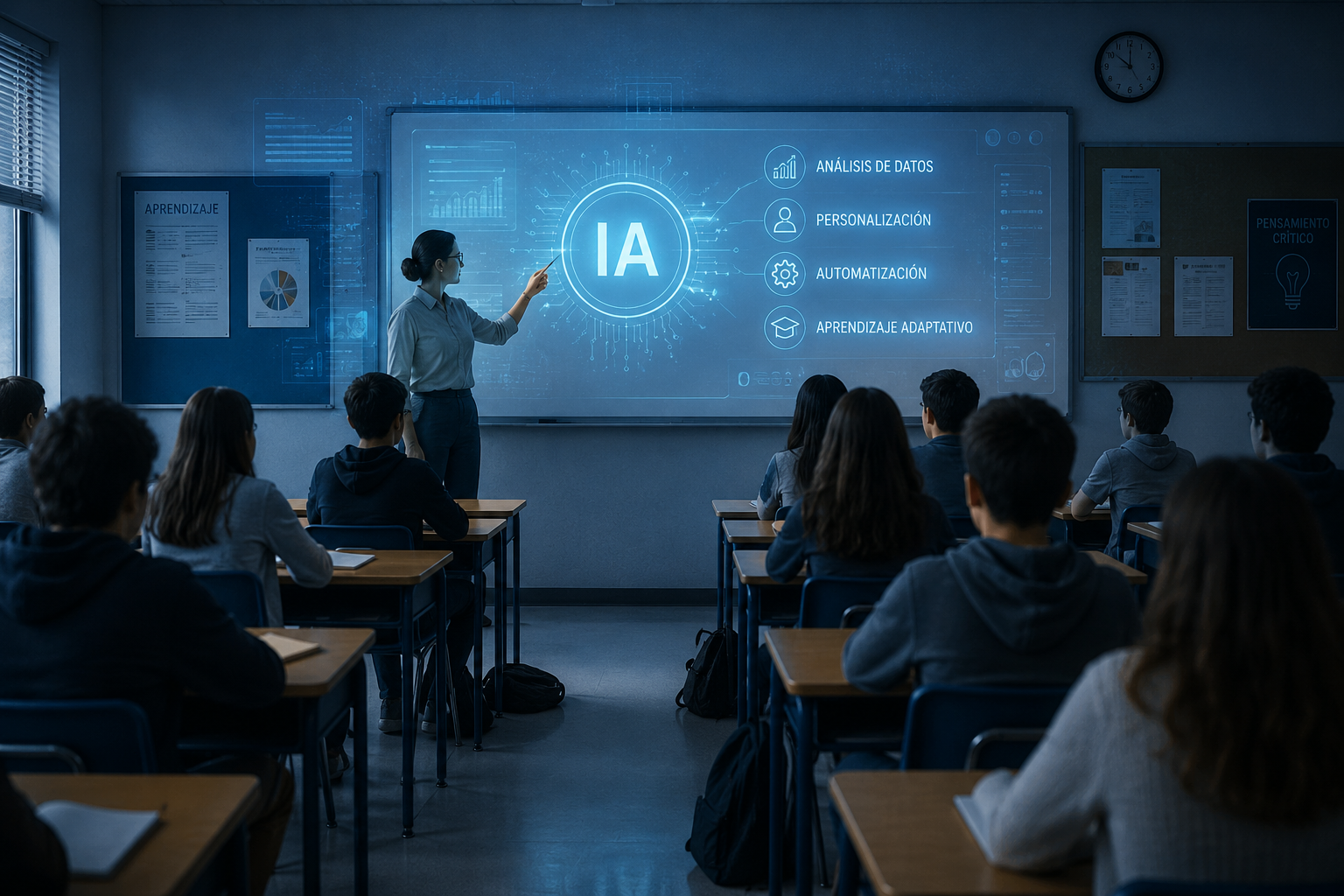
The cover of a recent international report on artificial intelligence in education captures the crux of the problem schools face today: a conventional classroom, students seated in rows facing the front, while an AI system projects content from the traditional position of the teacher. The scene is bathed in a blue glow designed to communicate modernity, yet the pedagogical architecture remains unchanged: frontal organization, receptive students, transmission-centered teaching, and the familiar structure of the classroom. In other words, it’s all bullshit.
Yet, report after report, we see this beautiful, blue glow of bullshit. These images are important because of what it reveals about the institutional imagination now available to education systems. Rather than asking how school time, assessment, or educational authority might change, the image places technology inside an existing function. AI appears as a substitute or supplement for what already happens, not as an occasion to reconsider the design of education itself.
Artificial intelligence is not destroying education. It is showing, with increasing clarity, how much of education still rests on fragile practices: assignments that confuse textual production with thinking, assessments that reward repetition before judgment, policies that outsource trust to administrative procedure, and innovation discourse that rarely changes the lived experience of learning.
Over the past few years, this tension has stopped being abstract. In staff rooms, leadership meetings, faculty committees, ministries, accreditation offices, and board discussions, AI has moved from technological curiosity to daily institutional problem. Student work now appears with uncertain authorship. Academic integrity policies are being rewritten under pressure. Educational systems are trying to respond to technologies that change faster than the institutional frameworks meant to govern them.
The rapid expansion of generative systems creates understandable pressure on educational organizations. School leaders, faculty, institutional managers, and policymakers must respond to immediate problems: academic integrity, curriculum redesign, data governance, and unequal access. Yet when the discussion remains limited to adoption, control, or instrumental training, artificial intelligence is reduced to a matter of implementation. That displacement impoverishes the debate, because the deeper question is not only which tools institutions will use, but how those tools reorganize the conditions under which learning, teaching, assessment, and institutional governance take place.
In this context, international organizations, ministries of education, universities, schools, and technology companies have produced guidance documents, training programs, policy statements, and frameworks intended to bring order to the incorporation of artificial intelligence in education. Such work can be useful, but it does not by itself explain what is at stake. The discussion should not be reduced to tools. It must also address deeper questions about knowledge, authority, assessment, and institutional governance.
The history of educational technology shows that this pattern did not begin with artificial intelligence (Cuban, 1986; Tyack & Cuban, 1995). Textbooks, calculators, personal computers, the internet, and mobile phones have each been presented, at different moments, as threats or promises of transformation. In each case, urgency, resistance, regulation, and modernization followed.
Yet new technologies have often produced more visible changes in devices than in the deeper organization of teaching and learning. Tyack and Cuban described this phenomenon decades ago in their studies of school reform.
Schools have a remarkable capacity to absorb innovations without altering the routines and structures that organize institutional life.
This point is central to the present moment. Despite decades of technological innovation, many institutions continue to organize learning through rigid structures and compliance models. Even when platforms, interfaces, and policy vocabularies change, the basic forms through which time is managed, performance is defined, and authority is distributed often remain in place. Artificial intelligence makes this tension more visible because it alters the conditions of access, production, and circulation of knowledge, while many institutions attempt to respond from organizational models designed for another era.
The contemporary crisis in education cannot be explained only by technological or administrative deficits. It also reflects a loss of institutional purpose, an erosion of trust, a reduction of teacher and learner agency, and a difficulty imagining different ways to organize learning. Artificial intelligence did not create that crisis. It made it harder to ignore.
The illusion of innovation
Many current AI initiatives present themselves as educational transformation, even though their primary uses continue to automate existing practices: generating exercises, correcting texts, producing summaries, monitoring academic misconduct, and accelerating administrative tasks (Xia et al., 2024; Kizilcec et al., 2024). In such cases, innovation becomes defined mainly as the incorporation of tools, while the harder institutional questions remain largely untouched.
How does assessment change when generative systems can produce complex texts? How should faculty or teacher time be redistributed when administrative tasks can be automated? How is authority reorganized when knowledge circulates through distributed systems? These questions require a deeper institutional and political discussion than the production of usage guidelines.
Recent work on AI governance warns that the accelerated adoption of opaque systems can strengthen automation, surveillance, and nontransparent decision-making if effective public oversight is absent (Taeihagh, 2025; Williamson, Molnar, & Boninger, 2024). In these cases, technology does not necessarily open a discussion about the purpose of learning. It can instead reinforce mechanisms that were already under pressure before the rise of generative systems.
In Beyond the digital enclosure (Moravec, 2026a), I analyze a risk that exceeds the adoption of imperfect tools: the displacement of educational authority toward external systems that institutions cannot fully audit. When criteria for classification, prioritization, moderation, and updating move outside the control of educational communities, technological innovation can become a form of institutional dependency.
Questions for educational leaders
Which AI platforms does the institution currently use?
What student, faculty, or institutional data do those platforms collect?
Who can audit the systems being used?
Which educational decisions are shaped by external providers?
What professional capacities do leadership and teaching teams need to develop?
Platforms, power, and educational sovereignty
The second problem concerns the role of major technology platforms in reorganizing education. Much of the AI infrastructure now entering schools, universities, training systems, and public agencies belongs to private companies that operate through closed development models, intensive data collection, and constant system updates. Educational institutions integrate tools whose internal mechanisms they cannot fully audit, modify, or supervise. This situation exceeds software adoption because it affects the conditions under which knowledge is produced, circulated, and validated.
Platforms do not merely provide services. They also organize interactions, prioritize content, register behavior, and shape forms of intellectual work. In educational settings, those decisions carry pedagogical significance because they influence which questions are asked, which sources appear relevant, which forms of production become suspect, and which forms of participation become normalized. The institution may retain formal educational responsibility, but part of its operational authority shifts toward systems designed and governed by external actors.
This phenomenon reflects broader debates about the concentration of technological power and the extraction of data. Critical research on digital platforms has shown how everyday activities can become sources of data, algorithmic influence, and institutional dependency (Benjamin, 2019; Couldry & Mejías, 2019; van Dijck, Poell, & de Waal, 2018).
Education participates in this dynamic when ordinary academic activities become part of private systems that educational institutions do not fully control.
Put plainly: the thinking, exploration, and intellectual production of students and educators can become commercial resources for external platforms.
The issue is not only privacy, although privacy is important. The central issue is governance. When private platforms control critical infrastructure for learning, institutions lose practical capacity to determine how their learning environments function. Updates follow corporate calendars, moderation criteria can change without local educational deliberation, and classification mechanisms often remain opaque to students, educators, and institutional leaders.
Under those conditions, institutions end up managing consequences they cannot always explain or correct.
In Beyond the digital enclosure (Moravec, 2026a), this dynamic is analyzed as a progressive loss of educational sovereignty: private platforms begin to define central aspects of institutional life that previously remained under local educational control. Dependency does not arise only through contracts or licenses. It also emerges through the everyday incorporation of metrics, interfaces, and decision criteria designed outside educational communities.
This issue matters across regions, but it does not appear in the same way everywhere. In high-income countries, institutional dependency may emerge through procurement, platform lock-in, analytics dashboards, assessment systems, and outsourcing of educational judgment. In lower- and middle-income countries, the problem often intersects with infrastructure inequality, donor agendas, language marginalization, and the importation of models designed elsewhere. In international education and development contexts, AI may deepen dependency when institutions adopt closed systems that organize knowledge, assessment, and interaction according to commercial or geopolitical priorities beyond local control.
The Global South faces particular vulnerabilities. Schools and universities may incorporate software produced in North America, Europe, or China while exposing student data, linguistic patterns, and traces of intellectual work to systems used to train external models. At the same time, institutions may import automated classification, assessment, and recommendation mechanisms built from cultural, linguistic, and economic assumptions that do not reflect local realities.
For this reason, the global debate should not remain limited to technical training or responsible use. It must also address educational sovereignty, audit capacity, democratic control of digital infrastructure, language justice, public accountability, and the institutional right to define educational purposes.
The exhaustion of performative leadership
Institutions often produce strategies, manuals, policy statements, and events about artificial intelligence to demonstrate responsiveness to technological change. Such activity performs understandable institutional functions: it organizes internal conversations, communicates public concern, and signals that the organization is keeping up.
However, it can also create a wide gap between discourse and practice when documents do not change the resources, responsibilities, or working conditions required to transform educational experience.
In many cases, these guidelines function as an institutional release valve. They allow the organization to show that it has done something, while much of the emotional, ethical, and operational work moves to individual teachers and faculty members who must decide, often alone, how to assess, what to allow, what to prohibit, and how to interpret student use of generative tools.
Over recent decades, the education sector has produced an extensive institutional literature on technological innovation. Much of it shares a predictable vocabulary: teacher training, equity, ethical use, pilot programs, and personalized learning. These elements can have value, but they lose force when they are not connected to decisions about budget, professional time, assessment, infrastructure, data ownership, and participation of educators and students in technological governance.
The problem, then, is not the existence of frameworks or recommendations. The problem is confusing discursive production with institutional transformation. When policies only regulate individual behavior, responsibility shifts toward educators and students while the technological systems that generate new risks remain opaque. As a result, people working and learning inside institutions absorb costs that rarely appear in policy documents: redesigning assessments, reviewing suspect work, adapting to changing platforms, and responding to contradictory expectations.
Artificial intelligence did not create these tensions. It amplified preëxisting conditions and made them more visible because it introduced systems capable of intervening in writing, synthesis, classification, and initial evaluation. For that reason, adequate institutional policy cannot be limited to regulating user behavior. It must also examine the material, technical, and political conditions that organize how these systems function within educational life.
Institutional responses to AI: Compliance or transformation.
Management Dimension
Performative Response (Compliance)
Institutional Transformation (Sovereignty)
Institutional Policy
Rapid publication of usage and sanction guidelines
Review of assessment formats and professional workload
Team Development
Isolated technical training on prompt use
Sustained development of institutional capacity and imagination
Institutional Climate
Deployment of detection and surveillance tools
Creation of environments grounded in trust, reflection, and judgment
Internal Processes
Administrative automation oriented toward control
Review of the educational purposes the institution is designed to serve
Beyond compliance
The deeper problem is not simply the incorporation of new tools. It is the development of institutional capacities for thinking educationally under conditions of accelerated change. Many organizations still respond to artificial intelligence through administrative categories designed to manage stability, control, and predictability.
Generative systems, however, raise questions that cannot be resolved only through technical regulation or bureaucratic compliance. They require institutions to reconsider what assessment means, how educational authority is distributed, which human capacities gain value, and which forms of educational experience deserve protection.
The discussion about artificial intelligence often oscillates between two limited positions: uncritical adoption and defensive rejection. Neither allows the deeper problem to be understood, because both keep attention fixed on the tool rather than on the institutional conditions that give it meaning. Recent debates on AI literacy suggest a different path: institutions must not only teach people to use generative systems, but also help them understand how those systems produce responses, which assumptions they carry, which risks they introduce, and how they affect the autonomy of educators and learners (Mills et al., 2024; Conrad & Kamperman, 2025).
The central question is not whether educational institutions will use artificial intelligence. The challenge is to define under what pedagogical, political, and organizational conditions these systems are incorporated, which forms of authority they displace, and which educational capacities they help develop.
Answering these questions requires institutions to revisit some of the assumptions that have organized much of contemporary schooling: transmission-centered teaching, standardized assessment, rigid administration of time, and separation between policy design, teaching, and learning. Many systems still operate through models conceived to manage stability, scarcity of information, and relatively predictable pathways. The expansion of algorithmic systems, automation, and distributed production of knowledge changes those conditions and makes many inherited institutional responses insufficient.
Assessment offers a clear example. When generative tools can produce coherent texts in seconds, mechanisms centered only on individual reproduction of information become insufficient.
Likewise, when access to knowledge no longer depends on memorization, the capacities education must value begin to change.
This shift requires institutions to reconsider:
the distribution of authority in learning environments;
the recognition of new forms of intellectual work;
the development of judgment in information-saturated contexts;
the place of creativity, collaboration, and interpretation in educational experience; and
the protection of autonomous thought in increasingly automated systems.
From this perspective, educational leadership cannot be reduced to technological implementation. It must also include governance, institutional purpose, and collective capacity to imagine alternatives. For institutional leaders, this requires a style of leadership less centered on the administration of compliance and more oriented toward creating conditions for professional judgment, responsible experimentation, and pedagogical trust. Many current problems in education do not derive from technological deficits, but from organizational models that no longer respond adequately to contemporary conditions.
Artificial intelligence did not create that situation. Its importance lies in the way it amplifies and exposes many of education’s contradictions. For that reason, the debate should not remain limited to adapting to new tools. It must also open a deeper discussion about how learning should be organized, how trust can be built, and which forms of educational experience deserve to be sustained in a context shaped by automation and digital platforms.
For many institutions, this discussion does not begin with sweeping structural reform. It begins with everyday decisions about assessment, professional time, pedagogical trust, and technological governance. The capacity to respond critically to artificial intelligence will depend less on the speed of adoption than on the institutional capacity to sustain judgment, collective deliberation, and professional autonomy under conditions of accelerated change.
The most critical part is identifying which aspects of human learning should remain at the center of educational experience.
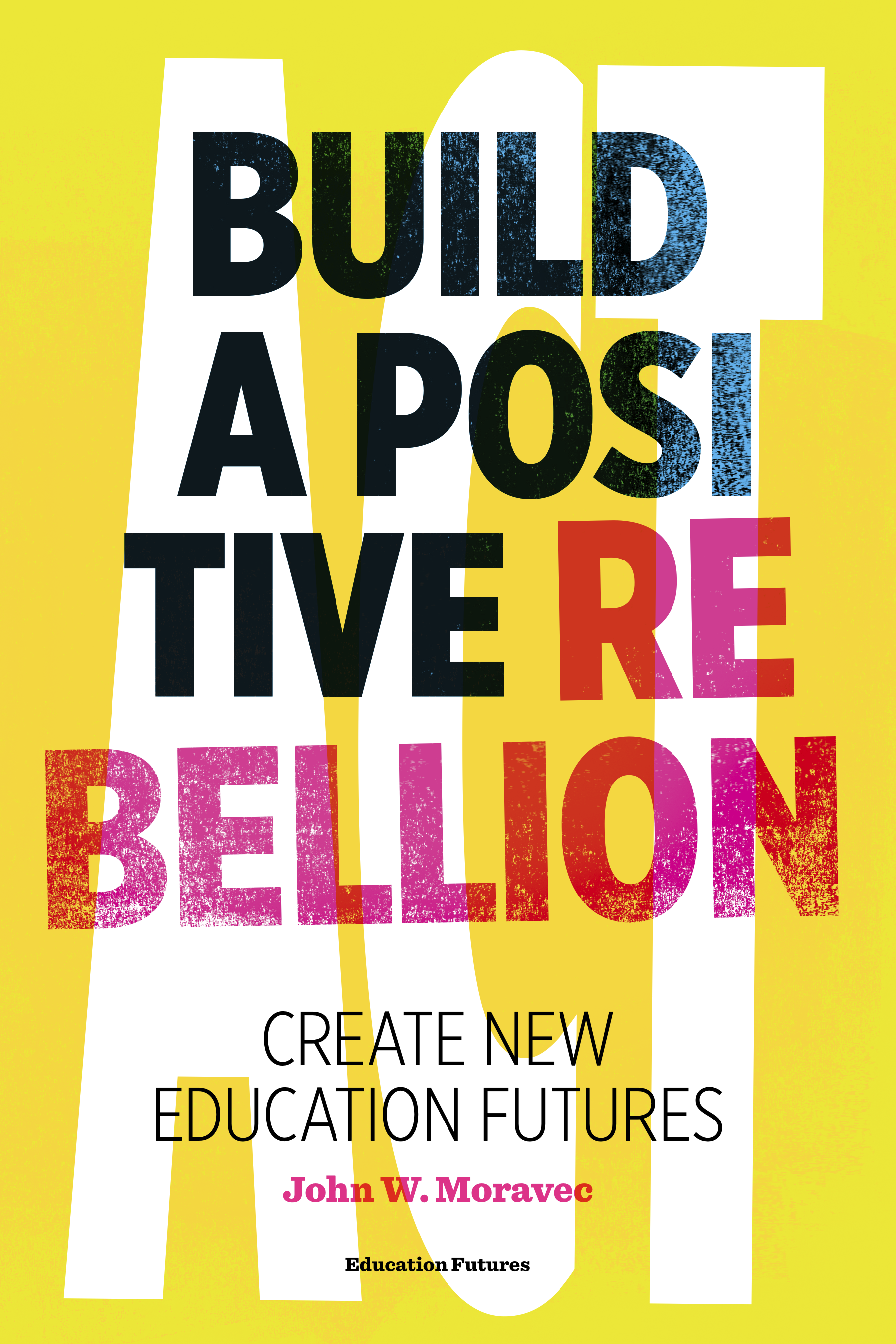
That discussion also runs through my book Build a Positive Rebellion: Create New Education Futures (Moravec, 2026b), where I explore how institutions can recover agency, trust, and collective imagination in response to educational models that no longer meet the conditions of the present.
Recommended readings
Benjamin, R. (2019). Race after technology: Abolitionist tools for the new Jim code. Polity.
Conrad, K., & Kamperman, S. (2025). Building critical AI literacy: An approach to generative AI. Thresholds in Education, 48(2), 142–158. https://eric.ed.gov/?id=EJ1483967
Couldry, N., & Mejías, U. A. (2019). The costs of connection: How data is colonizing human life and appropriating it for capitalism. Stanford University Press.
Kizilcec, R. F., Huber, E., Papanastasiou, E. C., Cram, A., Makridis, C. A., Smolansky, A., Zeivots, S., & Raduescu, C. (2024). Perceived impact of generative AI on assessments: Comparing educator and student perspectives in Australia, Cyprus, and the United States. Computers and Education: Artificial Intelligence, 7, 100269. https://doi.org/10.1016/j.caeai.2024.100269
Mills, K., Ruiz, P., Lee, K. W., Coenraad, M., Fusco, J., Roschelle, J., & Weisgrau, J. (2024). AI literacy: A framework to understand, evaluate, and use emerging technology. Digital Promise.
Moravec, J. W. (2026a). Beyond the digital enclosure: AI, coloniality, and the pursuit of educational sovereignty. Learning Futures and Emerging Technologies, 34(3). https://doi.org/10.1108/LFET-01-2026-0004
Moravec, J. W. (2026b). Build a positive rebellion: Create new education futures. Education Futures. https://positiverebellion.org/
Tyack, D., & Cuban, L. (1995). Tinkering toward utopia: A century of public school reform. Harvard University Press.
van Dijck, J., Poell, T., & de Waal, M. (2018). The platform society: Public values in a connective world. Oxford University Press.
Williamson, B., Molnar, A., & Boninger, F. (2024). Time for a pause: Without effective public oversight, AI in schools will do more harm than good. National Education Policy Center. https://nepc.colorado.edu/publication/ai
Xia, Q., Weng, X., Ouyang, F., Lin, T. J., & Chiu, T. K. F. (2024). A scoping review on how generative artificial intelligence transforms assessment in higher education. International Journal of Educational Technology in Higher Education, 21(1), 40. https://doi.org/10.1186/s41239-024-00468-z
]]>
The tool was never the problem: Phone bans, AI, and the failure of controlJohn Moravechttps://educationfutures.com/post/the-phone-ban-was-never-about-phones/2026-05-05T10:54:08-05:00
A new study in the U.S. on school phone bans gives us some food for thought. Researchers examining the…
]]>
A new study in the U.S. on school phone bans gives us some food for thought.
Researchers examining the use of lockable phone pouches across U.S. schools found what many would expect at a surface level: phone use drops. But the downstream effects are harder to reconcile with the policy narrative. In the first year, disciplinary incidents increase and student well-being declines. Over time, those effects fade and even reverse. Academic outcomes, meanwhile, remain largely unchanged (Allcott et al., 2026).
It is tempting to read this as a simple story about adjustment. Take something away, people react, then they adapt. There is plenty of research like this in organization psychology, so there should not be much surprise. But we risk missing the more important question:
If removing phones produces disruption, what does that say about the dependency structure schools have allowed to develop?
Phones did not create distraction inside schools. They absorbed it. They filled time, mediated social interaction, and compensated for weak engagement. When they disappear, the system does not suddenly produce better learning conditions. It exposes the gaps that were already there.
The response to those gaps is revealing. Instead of redesigning learning, schools tighten control. This means more rules, more enforcement, more attention to behavior. The policy thus addresses the visible symptom, but not the underlying condition.
This pattern reflects a deeper issue that predates phones, AI, or any specific technology:
Education does not have a technology problem. It has a model-of-learning problem.
For generations, schooling has been organized less around learning than around management. It groups students by age, moves them through fixed schedules, divides knowledge into discrete units, and evaluates performance through standardized outputs. These structures made sense in systems that needed to coördinate large numbers of people efficiently. They made schooling visible and easier to manage to administrators and policymakers.
But visibility is not the same as learning.
It is important to understand that distinction because the conditions that sustained the model no longer hold. Access to information is no longer scarce. Tools can assist, extend, or replace parts of human cognition, augmenting how we learn and “know” things. The boundary between individual and distributed thinking via machines has blurred.
Yet the structure of schooling remains largely intact.
That is why the last decade feels incoherent. Not long ago, schools could not get enough technology into classrooms. Devices promised access. Platforms promised personalization. “EdTech” became a stand-in for “innovation” because the system rarely asked what educational technology was supposed to change. Now the same system retreats from innovation back to the comfort of control, locking phones away and treating generative AI as a threat to academic integrity.
This may be rationalized as a system trying to restore control over conditions it no longer understands. When a tool fits the existing model, it is adopted. When it exposes the limits of the model, it is restricted.
AI brings this contradiction into sharp focus. Students and teachers are already using these tools, often faster than institutions can respond. The gap between policy and practice continues to widen (RAND Corporation, 2025). In an increasing number of contexts, AI is embedded in how work gets done.
However, the effects of AI are not uniform. Evidence suggests that AI can support learning when it is used to extend reasoning but undermine it when it replaces cognitive effort (Khalil & Er, 2025). The tool can produce both outcomes. The difference lies in how learning is designed. This creates a problem that the current system is not equipped to handle.
For decades, education has relied on static outputs as proxies for learning. Essays, exams, and assignments were treated as evidence of individual cognition. AI breaks the assumptions we’ve long held about the assessment system. It can produce outputs that look like learning without revealing to what extent thinking occurred.
If a student can generate a high-quality response with minimal effort, the issue should not be centered around academic dishonesty. It is that the approach we have relied on no longer carries the meaning we once assigned to it.
Researchers might describe AI and assessment as a “wicked problem,” not because it is complicated, but because it cannot be resolved within the current structure (Corbin et al., 2025). Efforts to preserve integrity through detection and surveillance attempt to restore visibility, but they do not address the underlying shift.
The system responds in the only way it knows how. It increases control. We see this in phone bans, AI detection tools, proctoring systems, and expansive policy statements about appropriate use. These measures of response to anxiety or paranoia create the appearance of order by reëstablishing the old regime, but they do not resolve the contradiction.
Decades ago, we faced a similar crisis with calculators. Calculators were eventually integrated because their function was limited and well-defined. They did not challenge the structure of assessment itself.
AI does and today’s challenges are thus wildly different. It operates across the full arc of thinking, from generating ideas to refining arguments. It does not simply assist with tasks. It reshapes them.
This is why the current moment feels unstable. The system is trying to apply old rules to a new form of cognition. As Albert Einstein is (mis)attributed to having said, “insanity is doing the same thing over and over again and expecting different results.”
And, in this case, the result is predictable: Control substitutes for design, policy substitutes for strategy, and restriction substitutes for equity. The gap between school and the world widens.
The way out does not lie in more restrictive policies or more enthusiastic adoption. It requires a different model of learning.
Assessment must move beyond static outputs toward evaluating process, reasoning, and judgment. Students need to demonstrate how they think, not just what they produce. Classroom practice must shift from controlling inputs to designing activity. The relevant question is not whether a student used AI, but what kind of thinking the task required and how the tool shaped that thinking.
Governance must move from prohibition to shared norms. Students and teachers need clarity about when and how tools are used, grounded in purpose rather than enforcement. Teacher preparation must also change. Educators cannot be expected to integrate tools effectively without frameworks that reflect how those tools alter cognition.
None of this represents a return to a previous version of education. The idea that the system can simply go back to promoting personal and community growth ignores the fact that it has never been structurally organized around those goals at scale.
That is the work ahead.
The phone ban study does not show that extreme control measures works. It shows that removal produces disruption and adaptation without addressing learning itself. AI does not create a new problem. It makes the existing one visible.
The system can continue to oscillate between adoption and restriction, or it can confront the harder question:
What does learning look like when tools are part of thinking?
Policymakers and school systems architects need to figure this out now.
]]>
NEW BOOK: Build a Positive Rebellion: Create New Education FuturesEducation Futureshttps://educationfutures.com/post/build-a-positive-rebellion-is-now-available/2026-04-07T10:42:00-05:00
Education Futures LLC announces the release of Build a Positive Rebellion: Create New Education Futures (April 7, 2026), a…
]]>
The book extends the work of Manifesto 25 in a context where education systems are asked to prepare learners for conditions they were not designed to address. AI is part of that shift, but it is not the only one. Political pressure, standardization, and risk control continue to narrow what can be done, while classrooms still follow routines built for another century. The result is a mismatch that shows up every day in what educators can do and what learners are asked to learn.
The premise is simple: there is no hope without action.
Build a Positive Rebellion responds to this gap by shifting the focus from critique to use. Structured as a companion and workbook, it develops 25 short essays, each aligned to a principle from Manifesto 25, and connects them to practical action. The aim is not to offer a single model, but to support individuals and teams working inside constrained systems who are trying to do something different with the space they have.
The book is designed for flexible reading. Chapters can be approached in any order, used in short sessions, and revisited as contexts evolve. Integrated cahiers invite reflection, adaptation, and application in local settings.
The digital edition is released as pay-what-you-want, including free access, under a Creative Commons license to support broad circulation. A paperback edition is available through Amazon and other booksellers. A Spanish edition is in production.
Education Futures invites educators, researchers, and system leaders to engage with the work in practice, share it within their networks, and extend it through their own contexts.
]]>
AI as anti-democratic infrastructure (and what education can do about it)John Moravechttps://educationfutures.com/post/ai-as-anti-democratic-infrastructure-and-what-education-can-do-about-it/2026-03-13T09:15:23-05:00
Alex Karp (2026), CEO of Palantir, recently framed AI as a force that will reduce the power of “highly…
]]>
Alex Karp (2026), CEO of Palantir, recently framed AI as a force that will reduce the power of “highly educated, often female voters, who vote mostly Democrat,” while increasing the power of non-college-educated, working-class men. He did not describe this as a deliberate shift to decide who holds influence, and one could argue this is a political extension of Hans Moravec’s paradox and its implications. However, educators must treat this framing as a warning, because schools and universities currently conscript themselves into the same technical stack that makes this power shift possible. When institutions centralize identity, content, and analytics into platforms (LMS, SSO, and enterprise data pipelines), they create the infrastructure necessary to rank, summarize, and throttle speech and access at scale.
Karp’s remarks read more completely once you place Palantir in its political and operational context:
“I no longer believe that freedom and democracy are compatible” (Thiel, 2009).
Peter Thiel, a Palantir co-founder, frames democracy as incompatible with freedom, which implies that democratic constraint is a problem to be engineered around rather than a safeguard. One must wonder, freedom for whom? When powerful figures around a company building state-facing data systems speak this way, education must stop treating AI as a “teaching tool” and start recognizing it as a governance choice. AI is controlled by a handful of actors. In a platform-mediated classroom, the tools they offer determine which questions are allowed, together with a set of prescribed answers. The universe of possibilities becomes very small and crafted to the interests of the few actors.
There is an additional layer of concern. The Brookings Institution’s Rebecca Winthrop warns that student dependence on AI can produce “cognitive stunting,” and argues that educators should impose guardrails to protect student development (Winthrop, 2026). Yet cognitive development is not the only democratic risk. Students can work hard and still lose agency if private systems control what information surfaces first, what gets compiled into “the answer,” and what topics are forbidden or engagement is limited to generality, all without audit rights or meaningful notice regarding data sources or quality. The system behaves as a black box.
This governance problem becomes concrete once generative AI moves from informal use into institutional infrastructure. Large language models generate fluent explanations, compress contested topics into short summaries, and enforce boundaries through refusals and safety filters. Those controls operate like policy because they shape what a student can easily ask, what a teacher can easily assign, and what a class can easily study. Institutions rarely receive stable change information when these boundaries move. A mid-term model update, for example, can change what a system refuses to do, how it paraphrases, or which sources it cites, without notice to instructors. When a campus integrates AI through vendor policies and design choices, it imports a private rule system into public education, then inherits responsibility for the consequences of upstream design decisions.
Palantir serves as a precedent for what this integration looks like in high-stakes settings. Wired describes Palantir’s Gotham as software designed for police and government clients that links people, places, and events for investigative and operational workflows (Tufekci, 2025). This does not necessarily mean that Palantir is “coming for schools.” It shows how an infrastructure and analysis firm designs software for institutional operations. Tools built for investigation, classification, and intervention normalize continuous monitoring because monitoring becomes cheap, searchable, and routinized. When similar logics enter education through analytics dashboards and AI “integrity” tooling, administrators gain a new appetite for measurement, and teachers inherit a larger burden of compliance work. Students learn participation carries visibility, and visibility carries risk.
The familiar “cognitive laziness” narrative misses the structural point. AI does not automatically weaken thinking; outcomes depend on task design and how educators structure revision and justification. The deeper democratic risk emerges when a small cluster of firms controls the systems (search, summarization, tutoring, and writing support) that make knowledge easy to retrieve and easy to trust. This steers attention and reasoning. Summaries carry framing choices. Over time, students learn to ask only what the system responds to smoothly, and institutions learn to design around what the system allows.
Sovereignty as a decolonial practice, not a compliance program
My upcoming article for Learning Futures and Emerging Technologies (in process) argues that educational AI adoption often reproduces colonial relations through four linked “lanes”: infrastructure, classification, epistemology, and labor. The claim is structural. Coloniality persists through contracts, defaults, and update cycles that shift authority upward while pushing responsibility downward. This is why the usual institutional response feels inadequate. A disclosure statement, a training module, or a classroom policy regulates user conduct at the edge while leaving platform governance untouched.
Seen through that lens, Karp’s and Thiel’s statements stop being background noise. They describe pressure toward a political outcome: fewer educated publics with the confidence and capacity to contest power. AI can contribute to that outcome in two ways at once. First, it can automate or devalue parts of professional knowledge work. Second, it can centralize the governance of inquiry itself. When the same private systems set boundaries for what can be asked, what counts as credible, and what gets flagged as risky, a democratic culture of contestation becomes harder to sustain. The educational system then trains adaptation to platform rules rather than practice in public reasoning.
The counter-move is to achieve sovereignty. In the manuscript’s terms, sovereignty is the effort to break the enclosure by relocating control over infrastructure, classification thresholds, epistemic boundaries, and repair labor back into institutions accountable to the public. That relocation attends toward a theory of institutional agency. A school is sovereign when it can reject defaults, inspect the system that governs inquiry, and exit without losing its records, context, and institutional memory. Without those capacities, “adoption” becomes a disguised transfer of jurisdiction.
Institutional sovereignty must disrupt each of these lanes.
Infrastructural coloniality manifests as an automated presumption of guilt when “pilots” become permanent dependencies. Identity, content, analytics, and support consolidate into one stack, and exit becomes reputationally and operationally costly. That dependency is politically important because it shifts the institution’s policy cycle onto the vendor’s update cycle. The vendor’s release becomes the institution’s rule change.
Classification coloniality shows up when institutions import automated suspicion. Detectors, proctoring flags, and predictive risk signals turn student writing and student behavior into a governance problem to be managed. This shifts the burden of proof downward, especially for students whose language use falls outside dominant registers. A system that makes accusation cheap changes the culture of learning. Students write to avoid flags. Teachers grade with an eye toward enforcement. Trust erodes, and self-censorship becomes a rational strategy for operating within the system.
Epistemic coloniality shows up when safety layers and ranking behavior pre-shape inquiry. Task refusals, softened answers, and hidden ranking rules determine what questions “work,” which sources surface first, and what construes a reasonable conclusion. A person who is not already an expert on a topic explored would have a very hard time navigating this. That boundary-setting becomes anti-democratic when it is uninspectable, unappealable, and only changeable through opaque updates controlled by a powerful few. In other words, it is a form of censorship and mind-shaping. It creates a practical politics of knowledge, where ideas or topics become frictional or meaningless, or twisted to serve the benefit of “the other.”
Labor coloniality shows up when public institutions subsidize private systems through repair work. Teachers and students verify hallucinations, manage conflicting information, rewrite assignments around platform limits, and absorb the workload of integrity processes triggered by opaque tools. The platform captures adoption and telemetry; the institution absorbs cost and conflict. This is labor exploitation by design.
These four lanes also clarify why sovereignty must be innovative. Institutions can design governance that behaves like democratic governance: deliberative, contestable, and reversible. They can treat model updates as policy changes that require notice and justification. They can treat refusal behavior as a curricular boundary that belongs to educators and communities rather than vendor risk teams. They can treat telemetry as extraction unless the institution can name its purpose, constrain its use, and stop it.
Innovation can also be collective. Universities can form consortia to share evaluation capacity, negotiate shared terms, and create credible exit paths. Systems can build “public option” AI services with transparent moderation rules and community oversight, either through open-weight deployments or institution-controlled models with published update practices. Institutions can also adopt a minimum sovereignty threshold for any AI system that touches assessment, discipline, or student support, then reject deployment when the threshold is not met. The point here is preserving self-determination for education and knowledge production.
When sovereignty is constrained
Vendors often resist meaningful sovereignty because sovereignty limits extraction. When institutions cannot secure jurisdiction over the system, they can still teach students how jurisdiction works. Schools should treat AI literacy as a study of authority under conditions of mediation. A prompt course teaches students to elicit cleaner outputs. It does not teach them how claims earn credibility. A stronger target is source discipline. Require students to attach primary sources to any factual claim they carry forward from an AI response, then grade the evidence chain rather than the polish of the prose. When a model summarizes a politically contested topic, require students to identify what the summary emphasized, what it compressed, and what it omitted, then compare that framing against abstracts, methods sections, or statutory text the summary claims to represent.
Task refusals and safety filters belong in the curriculum for the same reason. When a model refuses to answer a question or “answers” by sidestepping it, it draws a boundary around inquiry and enforces it without deliberation or appeal. Students should learn to treat that boundary as a constraint on scholarship: name it, probe it, and document its effects. This practice involves tracking which topics trigger refusals, which yield softened answers, and which sources appear when the system does respond. That work keeps the limits of inquiry open for inspection and questioning, which is a core democratic value at stake.
Repair labor and due process as anti-extraction
AI adoption imposes a hidden tax on public institutions. Teachers verify claims, correct confident errors, redesign assessments to reduce false accusations, and spend time in meetings and documentation when detection tools trigger integrity procedures. Students do parallel work when they validate outputs and defend authorship. This is not incidental friction. It is a transfer of labor from public education into the stabilization of private systems. Institutions should treat that labor as evidence about how the system governs. A tool that routinely produces anxiety and dispute governs through suspicion rather than support.
Due process belongs at the center of AI policy because classification systems produce harms through opacity. Institutions should adopt a clear procedural standard: no adverse action based solely on automated detection. They should require human review, transparent standards of evidence, and remedies that do not depend on students disproving opaque algorithmic claims. These safeguards protect learning as a space where students can experiment, revise, and dissent without being trapped in a permanent presumption of guilt.
Governance has authors. Karp chose to describe AI as a lever for weakening a specific electorate. Thiel chose to cast democracy as a problem for freedom. Education must treat these statements as evidence about the political environment in which AI infrastructure is being built. The response is not more training modules. It is institutional imagination that reclaims jurisdiction across the four lanes: infrastructure that remains governable, classification that remains contestable, epistemic boundaries that remain visible, and labor that remains recognized rather than extracted.
Moravec, J. W. (in process). Beyond the digital enclosure: AI, coloniality, and the pursuit of educational sovereignty. Learning Futures and Emerging Technologies.
]]>
Second channel resilience: Preserving educational coördination in low-connectivity environmentsJohn Moravechttps://educationfutures.com/post/resilient-second-channel/2026-01-16T10:06:45-06:00
Field notes I thought it would be interesting to share some research notes from an exploratory inquiry into whether…
]]>
Field notes
I thought it would be interesting to share some research notes from an exploratory inquiry into whether LoRa-based mesh communication can support learning and teacher professional development programs when electricity and internet access remain unreliable. I do not present this as a definitive evaluation of LoRa or Meshtastic, but as field-informed experimentation intended to clarify where low-data mesh networking fits, what it enables, and what limits it. This work was performed throughout 2025.
The project reported here constitutes exploratory research into low-data communication for education in low-connectivity environments. It emerged from my experience in Sierra Leone connected to a digital coaching initiative, where coaching and learning activities continued locally while the return flow of program data repeatedly failed under unstable electricity and intermittent internet access. In practice, devices existed and effort existed, but the coördination layer degraded. Observations, checklists, and follow-up notes remained stranded on phones or paper. Program leaders then faced a problem that decisions had to be made with partial visibility.
This constraint reframed the technical question. Rather than asking how to deliver richer online learning experiences, I asked what minimal information must move for an education program to remain responsive. Many educational systems can tolerate delays in content delivery, but they cannot tolerate persistent breakdowns in coördination. Scheduling, basic reporting, safety and access updates, and short guidance for teachers and facilitators often matter more than real-time media. I therefore focused on whether a resilient, low-bandwidth second channel could carry essential messages when the primary channel fails. By “second channel,” I mean a parallel path for small packets of coördination data that continues to function when conventional internet connectivity is absent or drops out.
The technical candidate was LoRa, a long-range, low-power radio technology that has been used for years in telemetry and sensor networks. What has shifted more recently is not the existence of LoRa, but the accessibility of user-configurable mesh tools that allow communities to build store-and-forward communication across real landscapes using inexpensive nodes. A common entry point is a small Meshtastic-compatible LoRa board such as a Heltec WiFi LoRa 32 (V4) or a LilyGo T-Beam. As of early 2026, typical retail pricing for these basic nodes sits in the approximate USD $20 to USD $40 range, before accessories such as higher-gain antennas, enclosures, or batteries.
Implementations such as Meshtastic make it plausible to deploy ad hoc mesh networking without specialist infrastructure, thereby extending LoRa from point-to-point use toward geographically distributed community communication. My interest in this shift was practical: if messages can travel through a mesh that tolerates delay and intermittent paths, then education programs might preserve core coördination functions even when internet service is absent. Because the network can be owned and maintained locally, it can also increase operational autonomy by reducing dependence on external operators, contracts, or centralized permissions.
Broadband vs. LoRa Mesh as a resilient second channel
Feature
Conventional Broadband (Primary)
LoRa Mesh (Resilient Second Channel)
Primary goal
High-throughput content delivery
Low-data coördination and persistence
Connectivity
Continuous / Real-time
Intermittent / Asynchronous
Data payload
Large (Video, Rich Media, Syncing)
Tiny (Text, Codes, Numeric Scores)
Infrastructure
Centralized towers/ISP
Decentralized, community-owned nodes
Power needs
High (Requires stable grid/fuel)
Very Low (Solar/Battery-powered)
Failure mode
System blackout on signal loss
“Store-and-forward” (Delays but delivers)
The power budget is as important as the radio link. Meshtastic’s own guidance frames typical node power draw in the range of a few hundred milliwatts under common configurations, which is low enough that a small power bank can keep a node running for days, depending on duty cycle, screen use, and whether GPS is enabled. In the same logic, small solar setups become plausible: devices designed for long-term deployment commonly pair a modest battery pack with a 5W panel to sustain operation in off-grid conditions, provided the installation has adequate sunlight and the configuration is tuned for efficiency.
This work is approached with an assumption that similar infrastructural constraints operate across multiple high-need contexts. Refugee settlements often combine high coördination demand with constrained power budgets and restricted network availability. In settings where access is socially or politically constrained, including initiatives supporting girls’ education in Afghanistan, conventional network-dependent models can become fragile or infeasible. These are distinct environments, but they share a common design pressure: systems must function when connectivity appears intermittently and unpredictably. Under these conditions, communication architectures that prioritize eventual delivery and low energy consumption may offer operational value, even if they cannot support high-throughput applications.
I emphasized practical behavior under imperfect conditions rather than laboratory benchmarking. This included an examinatino of hardware feasibility, message delivery patterns, and the plausibility of educational workflows that can tolerate latency, partial loss, and limited payload size. I used Meshtastic as a testbed because it provides text-based messaging, store-and-forward routing, and automatic mesh formation among battery-powered nodes. My intent was to understand what educational tasks the medium can support and what kinds of environments undermine it.
In practice, the user interface does not require typing on the radio itself. Most deployments pair the node to an existing smartphone over Bluetooth, and the user composes messages in the Meshtastic mobile app, which keeps the interaction pattern familiar even when the transport layer is not.
I structured the exploration around three use cases. Each reflects a different educational function: program monitoring, community coördination, and instructional support. Together they allowed me to evaluate whether LoRa mesh networking supports only interpersonal messaging, or whether it can sustain elements of the information infrastructure that education systems often assume will be delivered through broadband.
The first use case addressed a central operational need in educational improvement programs: returning structured data for centralized collection and analysis. Observation-based frameworks and coaching models depend on the ability to aggregate results, identify trends, and respond through targeted support. In many low-connectivity settings, the bottleneck is not collecting data at the point of practice; it is transmitting it in a timely and reliable manner. I explored whether observation checklists, numeric scores, and short annotations could be encoded into compact message payloads and transported through a mesh to a location where data can be consolidated. In a simple workflow, a coach submits a coded message locally, intermediary nodes forward it opportunistically, and a gateway node later synchronizes with a laptop or other upstream channel when connectivity becomes available.
One practical way to implement that upstream handoff is to place a single gateway node near intermittent internet access, for example a school office that sometimes has Wi-Fi, or a location where a shared 3G hotspot appears periodically. When configured for MQTT, that node can uplink the mesh packets it observes to an MQTT broker whenever it sees connectivity, effectively pushing queued field messages to cloud services without requiring every participant to have internet access. In effect, the gateway acts as a bridge that “drains” queued messages from the mesh into a cloud database whenever an uplink becomes available.
This use case appeared most promising when aligned with the realities of program timelines. Many monitoring systems do not require minute-by-minute reporting; they require regular and trustworthy reporting. When messages arrive within hours or within a day, they can still support program oversight, quality assurance, and feedback planning. Under that lens, the key requirement becomes reliability under delay rather than immediacy. That requirement matches store-and-forward mesh logic more closely than it matches conventional web platforms optimized for constant synchronization.
The second use case examined a community information layer that resembles bulletin board systems in its basic logic. Such systems assume asynchronous participation, local relevance, and limited bandwidth, all of which map well to LoRa constraints. Within a mesh, a lightweight posting and retrieval model can support announcements, schedules, short guidance notes, and peer-to-peer exchange without requiring a centralized server. Educational value emerges through routine coördination that often gets overlooked in technology planning: notifying facilitators about meeting times, communicating changes in access or safety, sharing local lesson adaptations, and routing questions to peers. When the system operates through persistence and eventual delivery, it can sustain coördination despite intermittent connectivity, provided that participants accept that communication does not always occur in real time.
This community layer also highlighted a behavioral effect of constrained bandwidth. When participants must write within strict limits, they often produce shorter, more deliberate messages. That constraint can reduce low-value chatter and privilege information that others can re-use. The effect depends on context and norms, but it suggests that low-bandwidth systems may support a distinct communication culture that differs from real-time chat platforms, with potential benefits for community coördination.
The third use case explored whether AI-mediated instructional support can be adapted to a low-data environment. I treat this as speculative because contemporary AI delivery models typically assume continuous interaction, stable connectivity, and large context windows. A constrained alternative is nonetheless conceivable. Devices can be preloaded with curated instructional resources, and the mesh can distribute prompts, mini-lessons, or short guidance packets authored centrally. Users can submit short queries or requests, and responses can be returned asynchronously when routes permit. Under this model, AI functions less as a conversational tutor and more as delayed coaching support, structured reference assistance, or guided practice that arrives in discrete chunks.
The primary limitation here is pedagogical rather than technical. Short queries often strip away situational context that makes guidance relevant. Delayed responses weaken dialogue and reduce opportunities for clarification. As a result, the strongest applications likely involve structured tasks, procedural guidance, and frequently asked questions rather than open-ended tutoring. Even within those constraints, this approach may hold practical value where qualified teachers are not consistently available, especially if positioned as support for local facilitation rather than as a replacement for human instruction.
Feasibility matrix for educational tasks over LoRa mesh
Task Category
Example Activity
LoRa Suitability
Constraint to Manage
Monitoring
Classroom observation scores
High
Requires coded templates (e.g., “Q1:4”)
Coördination
Change in meeting time/location
High
Latency (may take 1–30 mins to propagate)
Instruction
Weekly teaching tip (short text)
Medium
Must be under ~200 characters
Support
AI-mediated Q&A
Low
Requires heavy distillation/summarization
Materials
Sending a 10-page PDF manual
Impossible
Requires physical distribution (e.g., SD card)
Across all three use cases, system behavior depended strongly on the interaction between radio propagation and landscape. The technology can perform reliably in settings where nodes maintain line-of-sight or where obstructions remain limited. Performance degrades in environments where dense vegetation, uneven terrain, and certain building materials attenuate or scatter radio signals. Dense tree cover can reduce effective range. Elevation changes can create signal shadows that fragment routes. Built environments can add complex losses depending on materials and layout. These conditions are not incidental; they are often the default in rural and peri-urban settings where education programs operate under constraint.
These environmental sensitivities shape a key practical implication: LoRa mesh networking shifts some reliability requirements away from software and toward deployment topology and maintenance routines. Increasing transmission power can help at the margins, but it cannot substitute for well-placed relay nodes when the landscape imposes structural barriers. Mesh density and strategic placement therefore matter at least as much as device specifications. In practice, the system becomes partly social infrastructure. Someone must host nodes, charge devices, notice failures, and maintain placement. Reliability becomes a function of both physics and stewardship.
These constraints also clarify the scale at which LoRa mesh networking fits educational needs. The approach appears best suited to bounded geographies where participants share space and purpose and where relay placement is feasible. Refugee camps match this profile because they combine density, coördination need, and constrained connectivity, and because a small number of strategically placed nodes can potentially provide robust coverage. Rural school clusters can also fit when schools are close enough to sustain a mesh and when communities can support relay placement at higher elevations or along travel corridors. Informal settlements may fit when local organizations can maintain devices and establish norms for use. At larger regional scales, the requirement for node density and the cumulative effects of environmental attenuation make the approach less practical without additional infrastructure layers. In some settings, the ability to coördinate locally without routing every interaction through centralized platforms is part of the value proposition, especially when trust and safety are live constraints.
A further implication concerns the relationship between low-data transport and the educational software stack. LoRa mesh networking can move messages, but it does not by itself create structured data collection, user workflows, or meaningful feedback loops. For monitoring and coaching, programs still require offline-first tools that support local storage, clear data entry formats, and synchronization strategies that treat delay as normal. For community coördination, systems still require message conventions, moderation norms, and routines for ensuring that critical notices propagate. For instructional support, systems still require curated content, task design, and safeguards against over-reliance on decontextualized guidance. In this sense, LoRa functions as a transport layer that can complement offline-first educational systems, but it cannot substitute for them.
I take from this work a broader design stance for education technology in constrained contexts. Systems should treat interruption and delay as baseline conditions rather than as exceptional failures. Many platforms designed for stable connectivity respond poorly to partial synchronization, producing inconsistent records and eroding trust. LoRa mesh communication encourages a more resilient approach: identify the minimal information flows that keep programs accountable and responsive, then engineer those flows to tolerate scarcity, delay, and intermittent paths. This stance does not resolve the structural inequities that constrain educational opportunity, and it should not be framed as an alternative to universal, affordable internet access. It does, however, provide a pragmatic option for preserving coördination and feedback when conventional network dependencies repeatedly fail.
A practical next step would be a pilot designed explicitly for a bounded community setting, with refugee camp education coördination representing a strong candidate based on the fit constraints observed. Such a pilot would specify the minimal data types to be transported, establish message templates and coding conventions, deploy a modest number of relay nodes based on terrain and obstructions, and implement simple maintenance routines for charging and monitoring node health. Evaluation would focus on delivery reliability under real operating conditions, the ease of community stewardship, and the effect on program responsiveness, particularly the speed and completeness with which observation and coördination information reaches decision-makers.
]]>
Cómo las grandes empresas tecnológicas están colonizando silenciosamente la educaciónJohn Moravechttps://educationfutures.com/post/bigtech-estan-colonizando-educacion/2025-12-28T16:04:24-06:00
Los educadores enfrentan una creciente sensación de preocupación frente a la inteligencia artificial. Nuevas herramientas ingresan a las aulas…
]]>
Los educadores enfrentan una creciente sensación de preocupación frente a la inteligencia artificial. Nuevas herramientas ingresan a las aulas más rápido de lo que las políticas pueden adaptarse. Las autoridades nacionales publican documentos de orientación que delinean principios para un uso seguro o ético. Las universidades agregan declaraciones en sus programas sobre transparencia y buena conducta. Las empresas ofrecen módulos de formación gratuitos que muestran a los docentes cómo integrar sus plataformas en los planes de clase. Estos esfuerzos tienen valor, pero se quedan en la superficie de un problema más profundo. La mayoría de las decisiones que dan forma a cómo funciona la inteligencia artificial ocurren lejos de quienes vivirán con sus consecuencias.
Cuando hablamos de “usar” inteligencia artificial en educación, a menudo pasamos por alto la realidad más amplia que enmarca su llegada. Las herramientas que ingresan a las aulas no son instrumentos simples. Provienen de un pequeño grupo de empresas que establecen las condiciones de acceso, definen las reglas de interacción y moldean cómo circula el conocimiento. La rápida expansión de estos sistemas está guiada, pero no por los educadores. Refleja las prioridades de empresas que se benefician cuando las instituciones adoptan sus plataformas como infraestructura predeterminada. Los educadores pueden recibir formación y módulos de seguridad, pero no participan en las decisiones que gobiernan el comportamiento de los modelos. Esta distancia crea una forma de dependencia que debilita el juicio profesional y desplaza el control fuera de la esfera pública.
Gran parte del diálogo actual trata a la inteligencia artificial como si perteneciera a la misma categoría que las calculadoras o los teléfonos móviles. Esta analogía beneficia a las grandes tecnológicas (las “BigTech”). Presenta la adopción como inevitable e inofensiva, y alienta a los educadores a centrarse en la gestión del aula en lugar de en las fuerzas estructurales que dan forma a las herramientas mismas. También oculta el hecho de que las tecnologías anteriores no incorporaban intereses económicos o políticos. La inteligencia artificial sí lo hace. Cuando recurrimos a analogías que aplanan estas diferencias, facilitamos que las empresas definan los términos bajo los cuales la educación se relacionará con ellas.
Exploro aquí esa brecha. Mi argumento es que la educación no puede cumplir con sus responsabilidades si aborda la inteligencia artificial solo como una cuestión de práctica y control en el aula. Los problemas más profundos se encuentran en la gobernanza, la capacidad institucional y la larga historia de cómo las escuelas responden a nuevas tecnologías. Para sostener este argumento, recurro a ejemplos del Índice Global de Preparación para los Futuros de la Educación (GEFRI), del Manifesto 25 y de Trampi.ar.
Abundancia de marcos y ausencia de agencia
La inteligencia artificial ingresa a la educación a través de un flujo constante de marcos y lineamientos. Estos delinean principios de transparencia y seguridad, y prometen ayudar a los docentes a gestionar el riesgo. Muchos provienen de instituciones creíbles, pero comparten una característica clave: se enfocan en el comportamiento de educadores y estudiantes, no en los sistemas que moldean sus decisiones. Como resultado, estos marcos normalizan la presencia de las grandes tecnológicas. Capacitan a los educadores para adaptarse a plataformas en lugar de cuestionar el poder que las sustenta.
Los marcos, por sí solos, no pueden compensar la realidad estructural de que docentes e instituciones no controlan los sistemas que se les pide “usar responsablemente”. Las guías éticas enfatizan el comportamiento individual antes que las prioridades de las organizaciones que construyen y despliegan la inteligencia artificial. Describen la práctica responsable como algo que se logra mediante vigilancia, documentación y revisión constante de resultados, mientras los sistemas mismos permanecen fuera del control institucional.
Este énfasis en el comportamiento del usuario señala un problema más profundo. Cuando la responsabilidad recae en el usuario pero el poder reside en el desarrollador, el marco se convierte en un contrato moral sin mecanismos de gobernanza compartida. Los educadores siguen reglas que no crearon. Navegan restricciones que no eligieron. Asumen el riesgo profesional asociado a sistemas que operan fuera de su campo de visión.
En ciclos tecnológicos anteriores, las escuelas regulaban las herramientas que permitían ingresar al aula y establecían los términos de su uso. Con la inteligencia artificial, el flujo se invierte. Las herramientas regulan a las escuelas. Los algoritmos determinan qué ven los estudiantes. Los filtros de contenido moldean lo que pueden preguntar. Los motores de recomendación fomentan formas particulares de indagación. Estos mecanismos operan de manera silenciosa, pero redefinen los límites de la enseñanza. El desplazamiento de la autoridad institucional hacia la autoridad de la plataforma introduce un desequilibrio estructural que muchos sistemas no están preparados para gestionar.
Este desequilibrio aparece en evaluaciones nacionales de preparación. GEFRI, por ejemplo, distingue infraestructura de innovación, capital humano, gobernanza y equidad. Muchos países obtienen puntajes altos en acceso a dispositivos y conectividad, pero más bajos en gobernanza, lo que señala una capacidad limitada para orientar y regular la tecnología en lugar de simplemente adoptarla. El resultado es un patrón en el que los sistemas educativos parecen preparados porque poseen los medios técnicos para usar nuevas herramientas, pero carecen de la profundidad institucional necesaria para guiarlas hacia objetivos públicos.
Los marcos ayudan a los educadores a usar la inteligencia artificial dentro de esos sistemas. No les otorgan influencia sobre cómo la inteligencia artificial evoluciona. Esta distinción importa porque la educación no es un entorno neutral. Es una institución pública encargada de apoyar el florecimiento humano, la vida cívica y la participación amplia en el conocimiento. Si los educadores solo reciben instrucciones sobre cómo actuar dentro del diseño de otros, la profesión pierde su capacidad de moldear cómo las tecnologías educativas sirven a la sociedad.
La inteligencia artificial como el capítulo más reciente de una larga historia de control
La inteligencia artificial se percibe como algo nuevo, pero los problemas que la rodean son familiares. Las escuelas han luchado durante mucho tiempo con nuevas tecnologías. Las calculadoras fueron vistas como atajos que perjudicarían el razonamiento. Los teléfonos móviles se presentaron como distracciones que destruirían la concentración. Incluso los libros impresos han sido, en distintos momentos, regulados mediante listas de títulos aprobados o retirados de las estanterías. En cada caso, las instituciones respondieron con una mezcla de miedo, restricción y eventual acomodación.
El patrón revela algo importante. Las escuelas tienden a abordar la tecnología como una cuestión de control más que de comprensión. El primer impulso es regular antes que preguntar qué tipo de cambio cognitivo o social representa la tecnología. Esta dinámica se repite ahora con la inteligencia artificial. Muchas políticas enfatizan la detección de conductas indebidas, la prohibición de ciertos usos o el monitoreo estrecho del comportamiento estudiantil. Estas respuestas abordan preocupaciones inmediatas, pero rara vez se involucran con los cambios subyacentes en epistemología, autoría y autoridad que trae la inteligencia artificial.
Esta tendencia al control en lugar de la indagación mantiene a la educación anclada a estructuras del pasado. El Manifesto 25 sostiene que los sistemas educativos dominantes responden a la incertidumbre global con mayor disciplina, expectativas estandarizadas y culturas rígidas de cumplimiento, buscando estabilidad mediante el miedo, el cumplimiento y el control.
La inteligencia artificial intensifica esta tensión. Las escuelas temen la copia, la desinformación y la erosión de la confianza. Al mismo tiempo, las empresas promocionan la inteligencia artificial como una solución a la escasez de mano de obra, la carga administrativa y la desconexión estudiantil. Los educadores sienten presión desde ambos lados: contener la inteligencia artificial para preservar la integridad, adoptarla para mejorar la eficiencia. Ninguno de estos impulsos aborda la pregunta más profunda sobre qué significa enseñar y aprender en un entorno moldeado por sistemas poderosos y opacos.
La educación requiere estructura. El desafío es advertir cuándo el control se convierte en un sustituto de la comprensión. La inteligencia artificial exige un enfoque más reflexivo. Invita a los educadores a examinar por qué repiten patrones restrictivos, qué temores expresan esos patrones y qué posibilidades ocultan.
La ilusión de “usar” la tecnología
A menudo asumimos que los docentes usan tecnología. Decimos que los educadores “usan” sistemas de gestión del aprendizaje, “usan” evaluaciones digitales y ahora “usan” herramientas de inteligencia artificial para planificar clases o evaluar trabajos. Este lenguaje implica agencia humana. Presenta al docente como operador y a la herramienta como instrumento.
Pero la realidad es más compleja. Las plataformas guían el comportamiento de maneras que se sienten naturales, pero están profundamente estructuradas. Las configuraciones predeterminadas influyen en lo que los docentes notan. Los motores de recomendación moldean lo que los estudiantes encuentran. Las capas de seguridad definen los límites del conocimiento aceptable. Los paneles de análisis determinan qué formas de evidencia parecen significativas. Los docentes operan estos sistemas, pero la arquitectura del sistema orienta sus elecciones.
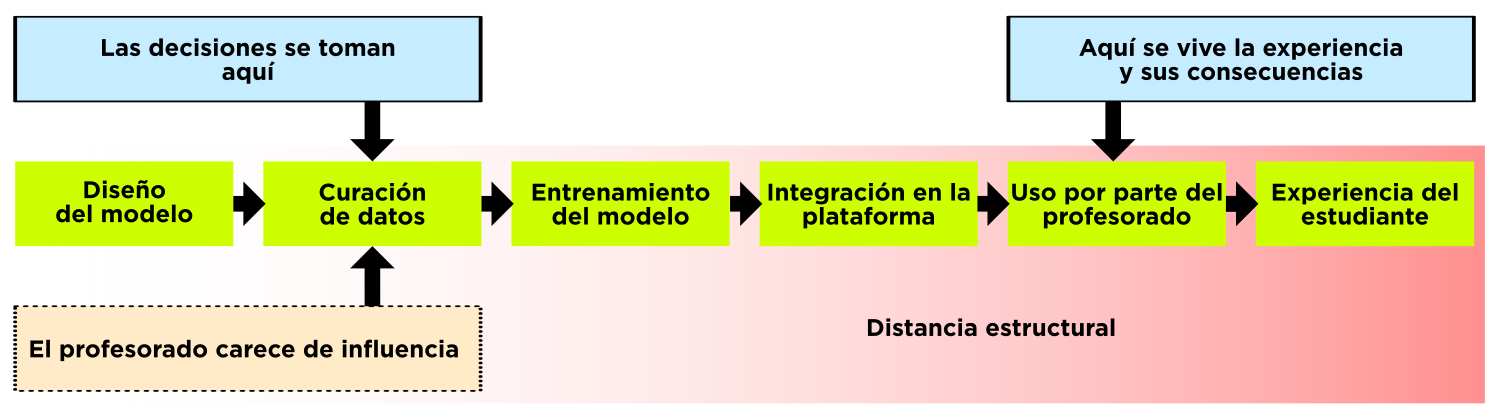
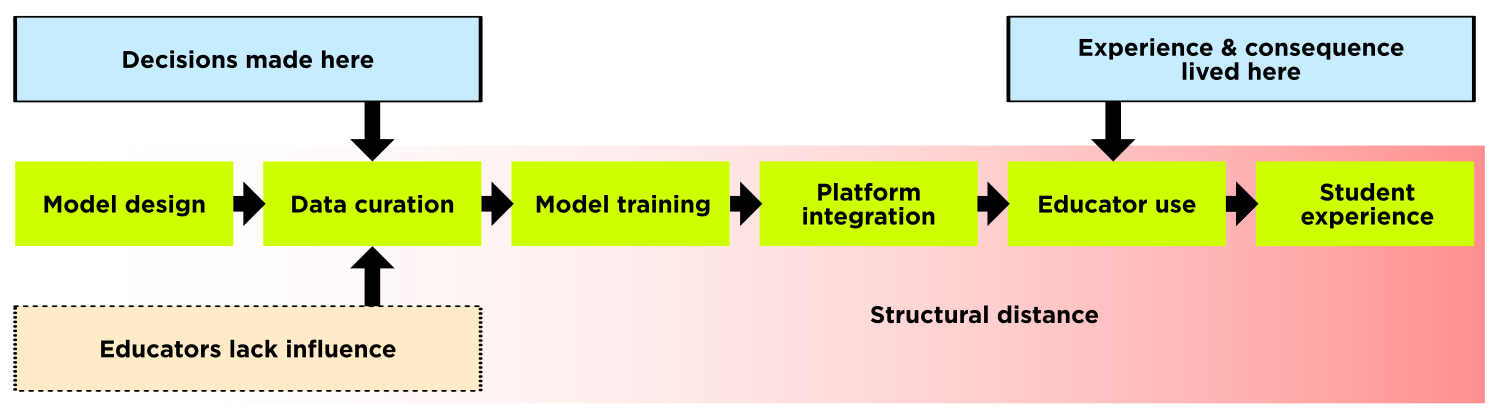
La cadena de suministro de la IA y el recorrido de decisiones
Aquí es donde la colonización se vuelve visible. La influencia de las grandes tecnológicas ingresa a través de esas mismas configuraciones predeterminadas, ajustes y decisiones de diseño que limitan la agencia del educador mientras dan la impresión de control. La interfaz fomenta acciones particulares. La capa de seguridad restringe lo que cuenta como indagación legítima. El panel de análisis encuadra el progreso en términos específicos. Mucho antes de que alguien tome una decisión, la plataforma ya ha moldeado las condiciones de la práctica y el desempeño.
Douglas Rushkoff captura esta dinámica en su llamado a “programar o ser programado”. Programar, en su sentido, no se refiere solo a escribir código, sino a comprender cómo se comportan los sistemas y cómo moldean la acción humana. Sin esa comprensión, los usuarios se adaptan a los sistemas en lugar de darles forma.
La inteligencia artificial educativa ahora entrena a sus usuarios de maneras sutiles. Los módulos de “uso ético” instruyen a los docentes sobre cómo actuar. Delinean responsabilidades y riesgos, pero rara vez explican cómo la plataforma gestiona datos, establece límites o interpreta principios éticos. La carga se desplaza hacia abajo. Los docentes se convierten en ejecutores de la conducta estudiantil, aun cuando no pueden ver dentro de los sistemas que definen las reglas. Los estudiantes, a su vez, aprenden a confiar en los resultados porque la interfaz los presenta como estables y fluidos.
Algunas herramientas desafían esta orientación. Trampi.ar, por ejemplo, trata a la inteligencia artificial como un objeto de examen más que como una fuente de verdad. Los estudiantes reciben resultados de personajes lúdicos que combinan perspicacia con error. Su tarea no es aceptar la respuesta, sino inspeccionarla. Desarrollan habilidades al notar patrones de razonamiento, momentos de exceso de confianza y los desajustes sutiles que a menudo se esconden en una prosa fluida. La plataforma entrena el escepticismo y una alfabetización más profunda en lugar de la aceptación ciega de resultados generados por máquinas.
Esto ilustra un cambio en cómo deberíamos percibir la inteligencia artificial en educación. Cuando los estudiantes tratan a la inteligencia artificial como algo que debe ser interrogado, se vuelven menos susceptibles a su ilusión de autoridad. Desarrollan prácticas de cuestionamiento, verificación cruzada y resistencia a la coherencia superficial del texto generado por máquinas. Estas prácticas trascienden el aula. Forman parte de una alfabetización pública más amplia necesaria en un mundo donde la inteligencia artificial se convertirá en un generador rutinario de contenido y afirmaciones.
Preparación sin soberanía
Los responsables de políticas suelen promover la “preparación” para la inteligencia artificial. Invierten en banda ancha, dispositivos y grandes plataformas digitales. Tratan el acceso como la barrera principal para participar en una economía tecnológica global. En este encuadre, la inteligencia artificial aparece como otra herramienta que las naciones deben desplegar para seguir siendo competitivas.
Sin embargo, la preparación no es lo mismo que el control. Un sistema puede contar con infraestructura robusta y aun así depender de tecnologías externas que no puede influir. Puede adoptar plataformas avanzadas mientras absorbe supuestos, valores y estructuras de gobernanza que se originan en otros contextos. La superficie se ve moderna, pero la capacidad de guiar la tecnología en el interés público sigue siendo limitada.
Estas brechas no equivalen a una pérdida formal de soberanía, pero crean condiciones en las que actores externos ganan influencia silenciosa. Cuando los sistemas públicos dependen de tecnologías que no pueden evaluar ni modificar de manera significativa, quedan sujetos a las prioridades y a los ciclos de actualización de las empresas que las proveen. La dependencia se convierte en el canal a través del cual emerge la colonización.
Las grandes tecnológicas explotan estas condiciones. Cuando las naciones dependen de infraestructura externa de inteligencia artificial, las empresas se convierten en socios no responsables en la gobernanza de la educación pública. Sus modelos moldean cómo los estudiantes buscan, escriben y formulan preguntas. Sus términos de servicio determinan qué datos salen de las aulas. Sus decisiones de producto influyen en currículos completos. Esto es colonización mediante dependencia: no impuesta por la fuerza, sino aceptada a través de la dependencia de sistemas privados como infraestructura pública.
El desafío no es rechazar herramientas externas. La colaboración global y la innovación compartida importan. El problema es cómo equilibrar la adopción con la capacidad de orientar. Los sistemas educativos necesitan la habilidad de cuestionar, negociar y exigir transparencia. Necesitan memoria institucional y experiencia profesional para evaluar nuevos sistemas antes de que se vuelvan arraigados. Sin este anclaje, la adopción de la inteligencia artificial puede acelerar la dependencia en lugar de fortalecer las instituciones públicas.
La responsabilidad mal ubicada tiene un costo social
Cuando la responsabilidad por el uso ético de la inteligencia artificial se deposita casi por completo en los individuos, la carga se vuelve insostenible. A los educadores se les pide monitorear la conducta estudiantil, asegurar el cumplimiento, gestionar riesgos de privacidad y revisar textos generados por inteligencia artificial en busca de precisión. Lo hacen en entornos donde tienen un control limitado sobre los sistemas mismos.
Este desequilibrio produce varios efectos. Los docentes experimentan una ansiedad creciente por conductas indebidas y confianza mal ubicada. Los estudiantes reciben señales mixtas sobre qué cuenta como aprendizaje legítimo. Las instituciones invierten tiempo en redactar políticas detalladas sobre inteligencia artificial, pero estos documentos a menudo desplazan el riesgo en lugar de abordar sus causas. Cuando algo sale mal, los individuos se sienten obligados a justificar sus decisiones incluso cuando el diseño de la plataforma moldeó esas decisiones.
El patrón se asemeja a una condición más amplia: los sistemas descargan la responsabilidad en los individuos mientras mantienen estructuras que resisten la transformación. Provistos de una ilusión de control, las personas se sienten responsables de resultados que no diseñaron y que nunca pueden influir por completo. Esta dinámica socava la agencia. Enmarca a la educación como un espacio de gestión de riesgos y cumplimiento más que como un lugar de indagación compartida y desarrollo con sentido.
Este patrón refleja una lógica colonial clásica. La responsabilidad fluye hacia abajo mientras la autoridad fluye hacia arriba. A los docentes se les pide salvaguardar la integridad y gestionar el riesgo, aun cuando no pueden influir en los sistemas que generan esos riesgos. Las grandes tecnológicas permanecen aisladas de la rendición de cuentas. Sus plataformas establecen las condiciones bajo las cuales las conductas indebidas se vuelven posibles, pero educadores y estudiantes cargan con las consecuencias.
Un enfoque más equilibrado alinearía la responsabilidad con la influencia real. Educadores y estudiantes deberían participar en las decisiones sobre qué herramientas adoptar, cómo evaluarlas y qué salvaguardas exigir. Las instituciones deberían demandar información clara de los proveedores sobre prácticas de datos, comportamiento de los modelos y limitaciones documentadas. Los responsables de políticas deberían crear mecanismos para auditorías independientes y supervisión comunitaria. Estas medidas desplazan la responsabilidad hacia arriba, hacia la gobernanza, en lugar de hacia abajo, hacia el cumplimiento individual.
Reequilibrar la relación entre educación y tecnología
Si la educación continúa aceptando un rol pasivo en la expansión de la inteligencia artificial, corre el riesgo de ceder su autonomía restante a sistemas construidos para prioridades corporativas más que públicas. La colonización en este contexto llega a través del consentimiento silencioso. Emerge mediante configuraciones predeterminadas, narrativas de inevitabilidad y la normalización constante del control externo. Los educadores pueden desarrollar más marcos, pero estarán siempre intentando ponerse al día con los cambios y perderán oportunidades para abordar el desequilibrio más profundo entre las instituciones que diseñan la inteligencia artificial y las instituciones que se espera que la absorban. En este espacio, las medidas de control se multiplican a expensas de la agencia y de la autoeficacia para aprender.
El trabajo que viene es institucional, cultural y político, además de requerir cambio técnico. Implica construir entornos donde docentes y estudiantes no sean solo cumplidores de reglas, sino co-diseñadores de su paisaje tecnológico. Implica reclamar tiempo, espacio y autoridad para la reflexión. Y requiere el coraje de cuestionar sistemas que prometen eficiencia pero debilitan la autonomía. Este trabajo comienza cuando los educadores se niegan a dejar que la inteligencia artificial defina los términos de su integración y, en cambio, colocan los valores de la educación en el centro de la conversación.
]]>
2025 GEFRI finds wide readiness gaps and a global innovation bottleneckEducation Futureshttps://educationfutures.com/post/2025-gefri-finds-wide-readiness-gaps-and-a-global-innovation-bottleneck/2025-12-15T08:56:26-06:00
The Global Education Futures Readiness Index (GEFRI) 2025 end-of-year snapshot shows a world that remains unevenly prepared for education…
]]>
The Global Education Futures Readiness Index (GEFRI) 2025 end-of-year snapshot shows a world that remains unevenly prepared for education futures. Across 177 non-microstate countries, the global average GEFRI score is 48.85 (on a 0–100 scale), with a range from 13.56 to 81.98 and a standard deviation of 17.00, indicating large variation across systems (data are current as of December 1, 2025).
GEFRI benchmarks readiness across five dimensions: Infrastructure, Human Capital, School Access and Gender Parity, Innovation, and Governance. The interactive tool is available at gefri.educationfutures.com.
At the top of the index, Denmark leads at 81.98, with Korea close behind at 79.60. Singapore (78.63), Switzerland (78.09), the Netherlands (77.84), Hong Kong SAR, China (77.86), and Sweden (77.30) also sit in the top tier. These countries show strength across multiple dimensions at once, which is important because shocks rarely arrive one at a time. Energy price spikes, demographic change, migration, climate disruption, and rapid diffusion of generative AI can stress infrastructure, workforce capacity, and governance in the same year. High performers tend to sustain public capability, align incentives, and translate strategy into implementation.
At the other end of the rankings, the lowest scores cluster in conflict-affected and high-fragility contexts where systems face compounding constraints. The Central African Republic posts the lowest score (13.56), followed by Somalia (14.87) and South Sudan (15.30). Other very low performers include Chad (15.58) and the Democratic Republic of the Congo (18.44). In these settings, low readiness reflects intertwined barriers: weak or damaged infrastructure, interrupted access to schooling, constrained teacher supply and training, and limited state capacity to plan, finance, and deliver reforms. When these constraints reinforce each other, “catch-up” becomes harder because each gain depends on progress in the others.
GEFRI composite scores by region
GEFRI also shows a large middle tier where progress remains possible but not guaranteed. Many countries have built basic coverage and expanded access, yet they struggle to convert those gains into resilient learning outcomes and future-ready capability. This is where policy coördination becomes increasingly critical. Systems in this range can improve quickly when they treat reform as an implementation discipline, focus on binding constraints, and sustain effort across electoral cycles.
The distribution underscores the stakes. Readiness shapes whether schools can keep teaching during crisis, whether teachers can use new tools without undermining rigor, and whether students can move from schooling into decent work. It also shapes whether emerging technologies, including generative AI, reduce workload through better design and support, or instead widen inequality through uneven access, uneven teacher capacity, and uneven governance of quality and ethics. In practical terms, readiness affects learning loss, labor productivity, and social trust.
Key global findings (December 2025 snapshot)
Global leaders cluster at the top, but no country nears a score of 90. The top 10 countries by composite score are: Denmark (81.98), Korea, Rep. (79.60), Singapore (78.63), Switzerland (78.09), Hong Kong SAR, China (77.86), Netherlands (77.84), Sweden (77.30), United Kingdom (77.03), Finland (76.87), and Austria (76.82).
Many systems remain in critically low-score bands. Among 177 countries, GEFRI scores fall into these bands: ≤30: 38 countries (21.5%); 31–45: 34 (19.2%); 46–60: 53 (29.9%); 61–75: 36 (20.3%); 76–90: 16 (9.0%); >90: 0 (0.0%).
Innovation is the most common binding constraint. When countries are assessed across Infrastructure, Human Capital, Innovation, and Governance, the most frequent lowest-performing dimension is Innovation (70 countries; 39.5%), followed by Governance (53; 29.9%), Human Capital (46; 26.0%), and Infrastructure (8; 4.5%). This pattern suggests many systems have expanded access and basic capacity faster than they have built the institutions, incentives, and talent pipelines that support sustained invention and scaling.
Regional gaps remain large. Average composite scores by region are: North America 74.10; Europe & Central Asia 65.85; East Asia & Pacific 55.04; Middle East & North Africa 50.57; Latin America & Caribbean 46.72; South Asia 40.68; Sub-Saharan Africa 28.31.
Fragility tracks a major readiness penalty. Countries flagged as fragile, conflict-affected, or violence-affected average 26.68, compared with 53.93 for non-FCV countries, a gap of 27.25 points.
What policy leaders can learn from GEFRI going into 2026
This snapshot points to a pragmatic lesson: continue investments into what works, then raise the binding constraint. In many countries, that means pairing investment in tools and connectivity with reforms that grow innovation capacity and strengthen governance for implementation, while rebuilding human capital pipelines that education systems and labor markets both trust.
“GEFRI shows that readiness is not a single investment,” said GEFRI creator, Dr. John Moravec. “Many systems built pieces of the future, but they did not yet build the ability to adapt at speed. Countries will gain the most by identifying their binding constraint and treating it as a national delivery problem to leapfrog ahead, not a pilot project.”
About GEFRI
GEFRI is an open benchmarking index built from globally comparable indicators, with documented methods for data cleaning, imputation, scoring, and confidence adjustments. It draws primarily on World Bank and UNESCO-linked sources, with attribution tracked in indicator metadata and the technical appendix. GEFRI flags microstates (population under 300,000) so they do not anchor global reference statistics, and it uses a structured approach to cleaning, imputing missing values, and producing dimension and composite scores.
GEFRI is a completely open, free, and transparent tool. Data are also available through a public, no-authentication API, including access to historical snapshots when available.
]]>
How Big Tech is silently colonizing educationJohn Moravechttps://educationfutures.com/post/how-big-tech-is-silently-colonizing-education/2025-11-25T09:36:51-06:00
Educators face a growing sense of concern about artificial intelligence. New tools enter classrooms faster than policies can adapt.
]]>
Educators face a growing sense of concern about artificial intelligence. New tools enter classrooms faster than policies can adapt. National authorities release guidance documents that outline principles for safe or ethical use. Universities add statements to their syllabi about transparency and good conduct. Companies offer free training modules that show teachers how to integrate their platforms into lesson plans. These efforts have value, yet they sit on the surface of a deeper problem. Most decisions that shape how AI works occur far from the people who will live with the consequences.
When we talk about “using” AI in education, we often miss the larger reality shaping its arrival. The tools entering classrooms are not simple instruments. They come from a small group of firms that set the terms of access, define the rules of interaction, and shape how knowledge circulates. The rapid spread of these systems is guided, but not by educators. It reflects the priorities of companies that benefit when institutions adopt their platforms as default infrastructure. Educators may receive training and safety modules, yet they do not participate in the decisions that govern model behavior. This distance creates a form of dependency that weakens professional judgment and shifts control away from the public sphere.
Much of the current dialog treats AI as if it belongs in the same category as calculators or mobile phones. This analogy serves Big Tech well. It frames adoption as inevitable and harmless, and it encourages educators to focus on classroom management rather than on the structural forces shaping the tools themselves. It also masks the fact that earlier technologies did not carry embedded economic or political interests. AI does. When we rely on analogies that flatten these differences, we make it easier for companies to define the terms under which education will engage with them.
I explore that gap here. My argument is that education cannot meet its responsibilities if it approaches AI only as a question of classroom practice and control. The deeper issues lie in governance, institutional capacity, and the long history of how schools respond to new technologies. To make this case, I draw on examples from GEFRI, Manifesto 25, and Goblinly.
An abundance of frameworks with an absence of agency
AI enters education through a constant stream of frameworks and guidelines. They outline principles for transparency and safety, and they promise to help teachers navigate risk. Many come from credible institutions, yet they share an important feature: they focus on the behavior of educators and students, not on the systems that shape their choices. As a result, these frameworks normalize Big Tech’s presence. They train educators to adapt to platforms rather than question the power behind them.
Frameworks alone cannot compensate for the structural reality that teachers and institutions do not control the systems they are told to “use responsibly.” Ethical guidelines emphasize individual behavior rather than the priorities of the organizations that build and deploy AI. They describe responsible practice as something achieved through vigilance, documentation, and consistent checking of outputs, while the systems themselves remain outside institutional control.
This emphasis on user behavior signals a deeper problem. When responsibility sits with the user but power sits with the developer, the framework becomes a moral contract without a mechanism for shared governance. Educators follow rules they did not create. They navigate constraints they did not choose. They bear the professional risk associated with systems that operate beyond their view.
In earlier technological cycles, schools regulated the tools they allowed into classrooms and set the terms of their use. With AI, the flow reverses. The tools regulate the schools. Algorithms determine what students see. Content filters shape what they can ask. Recommendation engines encourage particular forms of inquiry. These mechanisms operate quietly, yet they redefine the boundaries of instruction. The shift from institutional authority to platform authority introduces a structural imbalance that many systems are not equipped to manage.
This imbalance appears in national readiness assessments. GEFRI, for example, distinguishes infrastructure from innovation, human capital, governance, and equity. Many countries rank high on access to devices and connectivity but score lower on governance, which signals limited capacity to steer and regulate technology rather than merely adopt it. The result is a pattern in which education systems look prepared because they possess the technical means to use new tools, yet lack the institutional depth needed to guide them toward public goals.
Frameworks help educators use AI within those systems. They do not grant influence over how AI evolves. This distinction matters because education is not a neutral environment. It is a public institution charged with supporting human flourishing, civic life, and broad participation in knowledge. If educators only receive instructions about how to act within someone else’s design, the profession loses its claim to shape how learning technologies serve society.
AI as the latest chapter in a long history of control
AI feels new, but the surrounding issues are familiar. Schools have long struggled with new technologies. Calculators were seen as shortcuts that would impair reasoning. Mobile phones were framed as distractions that would destroy concentration. Even printed books have, at various times, been governed by lists of approved titles or removed from shelves. In each case, institutions responded with a mix of fear, restriction, and eventual accommodation.
The pattern reveals something important. Schools tend to approach technology as a matter of control rather than understanding. The first instinct is to regulate rather than ask what kind of cognitive or social shift the technology represents. This dynamic repeats now with AI. Many policies emphasize detection of misconduct, prohibition of certain uses, or close monitoring of student behavior. These responses address immediate concerns, yet they rarely engage with the underlying shifts in epistemology, authorship, and authority that AI brings.
This tendency toward control rather than inquiry keeps education tethered to past structures. Manifesto 25 argues that mainstream education systems respond to global uncertainty with tighter discipline, standardized expectations, and rigid compliance cultures—seeking stability through fear, compliance, and control.
AI heightens this tension. Schools fear cheating, misinformation, and the erosion of trust. At the same time, companies market AI as a solution to labor shortages, administrative burden, and student disengagement. Educators feel pressure from both sides: contain AI to preserve integrity, adopt AI to improve efficiency. Neither impulse addresses the deeper question of what it means to teach and learn in an environment shaped by powerful, opaque systems.
Education requires structure. The challenge is to notice when control becomes a substitute for understanding. AI compels a more reflective approach. It asks educators to examine why they repeat restrictive patterns, what fears those patterns express, and what possibilities they obscure.
The illusion of “using” technology
We often assume that teachers use technology. We say that educators “use” learning management systems, “use” digital assessments, and now “use” AI tools to plan lessons or evaluate student work. This language implies human agency. It frames the teacher as the operator and the tool as the instrument.
But the reality is more complex. Platforms guide behavior in ways that feel natural yet are deeply structured. Default settings influence what teachers notice. Recommendation engines shape what students encounter. Safety layers define the boundaries of acceptable knowledge. Analytics dashboards determine which forms of evidence appear meaningful. Teachers operate these systems, but the system’s architecture steers their choices.
The AI supply chain and decision pathway
This is where colonization becomes visible. Big Tech’s influence enters through those same defaults, settings, and design decisions that limit educator agency while giving the impression of control. The interface encourages particular actions. The safety layer narrows what counts as legitimate inquiry. The analytics dashboard frames progress in specific terms. Long before anyone makes a decision, the platform has already shaped the conditions of practice and performance.
Douglas Rushkoff captures this dynamic in his call to “program or be programmed.” Programming in his sense refers not only to writing code but to understanding how systems behave and how they shape human action. Without that understanding, users adapt to systems rather than shape them.
Educational AI now trains its users in subtle ways. “Ethical use” modules instruct teachers on how to act. They outline responsibilities and risks but rarely explain how the platform manages data, sets boundaries, or interprets ethical principles. The burden shifts downward. Teachers become enforcers of student conduct, even though they cannot see inside the systems that define the rules. Students, in turn, learn to trust outputs because the interface presents them as stable and fluent.
Some tools challenge this orientation. Goblinly, for example, treats AI as an object of examination rather than a source of truth. Students receive outputs from playful personas that blend insight with error. Their task is not to accept the answer but to inspect it. They build skill by noticing patterns of reasoning, moments of overconfidence, and the subtle misalignments that often hide in fluent prose. The platform trains skepticism and deeper literacy over blind acceptance of machine outputs.
This illustrates a shift in how we should perceive AI in education. When learners treat AI as something to interrogate, they become less susceptible to its illusion of authority. They develop practices of questioning, cross-checking, and resisting the superficial coherence of machine-generated text. These practices carry beyond the classroom. They form part of a broader public literacy needed in a world where AI will become a routine generator of content and claims.
Readiness without sovereignty
Policymakers often advocate for AI “readiness.” They invest in broadband, devices, and large digital platforms. They treat access as the primary barrier to participation in a global technological economy. In this framing, AI appears as another tool nations must deploy to remain competitive.
Yet readiness is not the same as control. A system can have robust infrastructure and still depend on external technologies that it cannot influence. It can adopt advanced platforms while absorbing assumptions, values, and governance structures that originate elsewhere. The surface looks modern, but the capacity to guide technology in the public interest remains limited.
These gaps do not amount to a formal loss of sovereignty, but they create conditions in which outside actors gain quiet influence. When public systems rely on technologies they cannot meaningfully evaluate or modify, they become subject to the priorities and update cycles of the firms that supply them. Dependence becomes the channel through which colonization emerges.
Big Tech exploits these conditions. When nations depend on external AI infrastructure, companies become unaccountable partners in the governance of public education. Their models shape how students search, write, and ask questions. Their terms of service determine what data flow out of classrooms. Their product decisions influence entire curricula. This is colonization through dependency: not imposed by force, but accepted through reliance on private systems as public infrastructure.
The challenge is not to reject external tools. Global collaboration and shared innovation matter. The issue is how to balance adoption with the capacity to steer. Education systems need the ability to question, negotiate, and demand transparency. They need institutional memory and professional expertise to assess new systems before they become entrenched. Without this grounding, AI adoption may accelerate dependence rather than strengthen public institutions.
Misplaced responsibility bears a social cost
When responsibility for ethical AI use is placed almost entirely on individuals, the burden becomes unsustainable. Educators are asked to monitor student conduct, ensure compliance, manage privacy risks, and check AI-generated text for accuracy. They do this in environments where they have limited control over the systems themselves.
This imbalance produces several effects. Teachers experience rising anxiety about misconduct and misplaced trust. Students receive mixed signals about what counts as legitimate learning. Institutions invest time writing detailed AI policies, yet these documents often shift the risk rather than address its causes. When something goes wrong, individuals feel compelled to justify their choices even when the platform design shaped those choices.
The pattern resembles a larger condition: systems offload responsibility onto individuals while maintaining structures that resist transformation. Provided an illusion of control, people feel accountable for outcomes they did not design and can never fully influence. This dynamic undermines agency. It frames education as a site of risk management and compliance rather than a space for shared inquiry and purposeful development.
This pattern mirrors a classic colonial logic. Responsibility flows downward while authority flows upward. Teachers are asked to safeguard integrity and manage risk, even though they cannot influence the systems that generate those risks. Big Tech remains insulated from accountability. Its platforms set the conditions under which misconduct becomes possible, yet educators and students bear the consequences.
A more balanced approach would align responsibility with actual influence. Educators and students should participate in decisions about which tools to adopt, how they are evaluated, and what safeguards are required. Institutions should demand clear information from vendors about data practices, model behavior, and documented limitations. Policymakers should create mechanisms for independent audits and community oversight. These measures shift responsibility upward into governance rather than downward into individual compliance.
Rebalancing the relationship between education and technology
If education continues to accept a passive role in the expansion of AI, it risks ceding its remaining autonomy to systems built for corporate priorities rather than public ones. Colonization in this context arrives through quiet consent. It emerges through defaults, narratives of inevitability, and the steady normalization of external control. Educators may develop more frameworks, but they will be forever trying to catch up with changes and will miss opportunities to address the deeper imbalance between the institutions that design AI and the institutions expected to absorb it. In such a space, control measures multiply at the expense of agency and enabling self-efficacy to learn.
The work ahead is institutional, cultural, and political, in addition to requiring technical change. It involves building environments where teachers and students are not only rule-followers but co-designers of their technological landscape. It involves claiming time, space, and authority for reflection. And it requires the courage to question systems that promise efficiency but weaken autonomy. This work begins when educators refuse to let AI define the terms of its integration and instead place education’s values at the center of the conversation.
]]>
Gamificamos el hacer trampa con IA …con un poco de ayuda de los duendesEducation Futureshttps://educationfutures.com/post/gamificamos-el-hacer-trampa-con-ia-con-un-poco-de-ayuda-de-los-duendes/2025-11-06T16:00:25-06:00
En Education Futures, creemos que el aprendizaje ocurre mejor cuando la curiosidad se encuentra con un poco de travesura—algo…
]]>
En Education Futures, creemos que el aprendizaje ocurre mejor cuando la curiosidad se encuentra con un poco de travesura—algo que a menudo se experimenta jugando. Con Trampi.ar (español) y Goblinly (inglés), estamos explorando qué sucede cuando gamificamos el hacer trampa con IA. Es decir, hacer trampa no para fomentar la deshonestidad, sino para construir una nueva forma de trampa ética que premie el pensamiento crítico, la transparencia y la reflexión.
Tanto Trampi.ar como su localización en inglés, Goblinly, parten de una verdad que muchos educadores encuentran incómoda: los estudiantes ya usan inteligencia artificial para apoyar su trabajo académico. En lugar de enmarcar esto como una falta, las plataformas lo utilizan como punto de partida para desarrollar alfabetización crítica, la capacidad de leer en profundidad, analizar, evaluar e interpretar el comportamiento y los sesgos del texto generado por máquinas.
En Trampi.ar, los estudiantes envían indicaciones a un elenco de “duendes” impulsados por IA, cada uno con tendencias retóricas, estilos de razonamiento y fallos interpretativos distintos. Las respuestas suelen ser ingeniosas pero inconsistentes, lo que invita a los estudiantes a identificar qué duende produjo cada respuesta y justificar sus elecciones. Esta actividad transforma un posible acto de plagio en una tarea estructurada de alfabetización que fortalece la lectura analítica, la metacognición y la argumentación. Las funciones gamificadas como duendes coleccionables, avatares personalizables y puntos de experiencia mantienen el interés mientras se enfoca en la comprensión y el juicio reflexivo.
A través de Trampi.ar, estas mismas experiencias se vuelven accesibles para estudiantes hispanohablantes en toda América. La localización conserva las mecánicas centrales de Goblinly pero adapta los matices lingüísticos y culturales del humor, el tono y el contexto, asegurando que los jugadores puedan explorar las peculiaridades del lenguaje generado por máquinas en su propio idioma.
Ambas versiones promueven una comprensión más profunda de cómo los modelos de lenguaje construyen significado, simulan razonamiento y presentan incertidumbre como certeza. Al aprender a detectar sesgos, inconsistencias o manipulaciones retóricas, los estudiantes fortalecen su capacidad de leer a la IA de forma crítica. Es decir, pasan de una fluidez superficial a una comprensión profunda. Lo que comienza como “hacer trampa” se convierte en un ejercicio de honestidad intelectual, una forma de trampa ética donde los aprendices descubren la lógica, los límites y las suposiciones latentes de las máquinas que ahora escriben junto a ellos.
¿Honor entre ladrones?
La idea de trampa ética conlleva una tensión productiva. En la superficie, contradice los fundamentos morales de la educación. Sin embargo, cuando se replantea como un acto de indagación abierta en lugar de engaño, se convierte en un camino hacia la integridad. En Trampi.ar, hay honor cuando los estudiantes dejan de ocultar su uso de herramientas de IA y comienzan a reflexionar sobre cómo funcionan. Es la diferencia entre usar un atajo para evadir el aprendizaje y usarlo para examinar cómo se construye el conocimiento.
Dentro de este espacio lúdico, los estudiantes se convierten en colaboradores de la travesura. Prueban ideas, descubren patrones en el razonamiento de las máquinas y aprenden de las interpretaciones de otros. Lo que podría parecer engaño se convierte en una búsqueda cooperativa de comprensión. Este juego compartido cultiva humildad: los aprendices descubren que ni humanos ni máquinas poseen autoridad completa sobre la verdad.
Un honor entre tramposos también señala un cambio moral en la relación de la educación con la tecnología. La honestidad en la era de la IA ya no significa evitar las herramientas que generan texto, sino reconocer su presencia y cuestionar su influencia. Invita a docentes y estudiantes a tratar la “trampa” como datos, una pista de lo que los aprendices consideran significativo, confuso o motivador.
Al interactuar con la IA de forma transparente, los estudiantes practican discernimiento, empatía y razonamiento ético. Aprenden que la línea entre asistencia y autoría no es fija, sino negociada. El humor hace que esta negociación sea accesible; transforma la ansiedad por la deshonestidad en curiosidad por la cognición. De esta manera, los duendes no son cómplices del mal comportamiento. Más bien, son guías para aprender a pensar de forma crítica, lúdica y responsable junto a las máquinas.
Esta mentalidad se extiende naturalmente al aula. Trampi.ar y Goblinly están diseñados tanto para jugar como para enseñar. Su estructura permite a los educadores traducir esta curiosidad y reflexión en experiencias de aprendizaje significativas y evaluables.
Enseñando con duendes
Para los educadores, Trampi.ar y Goblinly incluyen un conjunto de recursos para el aula que convierten la exploración lúdica en aprendizaje estructurado. La Guía del Docente (actualmente disponible para socios piloto) describe objetivos, estrategias de discusión y alineación con estándares de alfabetización y ciencias. Planes de clase complementarios muestran cómo adaptar la plataforma a diferentes metas de aprendizaje y áreas temáticas:
Análisis de tono y punto de vista: Los estudiantes interpretan la respuesta de un duende a una pregunta histórica como “Explica las causas de la Revolución Francesa para un grupo de estudiantes poco interesados.” A través de anotaciones y discusión guiada, identifican señales lingüísticas que indican sesgo o neutralidad, y luego escriben sus propias narrativas históricas en voces distintas.
Evaluación del razonamiento científico: En juego grupal, los estudiantes examinan una explicación defectuosa de un duende sobre un proceso como la fotosíntesis. Trabajando en colaboración, identifican debilidades usando el modelo de afirmación–evidencia–razonamiento, reescriben la respuesta para mayor claridad y reflexionan sobre cómo el lenguaje moldea la argumentación científica.
Indagación interdisciplinaria: Los docentes pueden integrar inglés y estudios sociales para explorar retórica y persuasión. Por ejemplo, los estudiantes evalúan respuestas de duendes a una pregunta como “¿Deberían prohibirse los celulares en las escuelas?” y luego redactan sus propios párrafos emulando la postura retórica de un duende mientras mantienen la integridad factual.
Cada plan incluye objetivos claros, práctica guiada e independiente, y estrategias de evaluación como respuestas anotadas, tickets de salida o entradas en el cuaderno.
Los docentes también pueden crear grupos de clase para seguir el progreso, revisar etiquetas de estudiantes y celebrar avances. Las tablas de clasificación se usan para motivar, no para competir, enfatizando la colaboración y la reflexión.
La guía de implementación recomienda pilotos pequeños, conexión con rúbricas de alfabetización existentes e integración con sistemas de gestión del aprendizaje para continuidad. Estos recursos aseguran que Trampi.ar se integre en aulas reales como un andamiaje para lectura profunda, razonamiento y discusión.
Únete a la prueba pública
Ambas plataformas están en fase piloto en toda América. Invitamos a docentes, escuelas y patrocinadores a ayudarnos a expandir este experimento en ética lúdica con IA.